UNITED STATES
SECURITIES AND EXCHANGE COMMISSION
WASHINGTON, D.C. 20549
FORM 10-K/A
(Amendment No. 1 )
For the fiscal year ended September 30 , 2025
OR
For the transition period from ____ to _____
Commission File No. 001-33794
(Exact name of registrant as specified in its charter)
| | | |
| (State or other jurisdiction of incorporation or organization) | (I.R.S. Employer Identification No.) | |
| | ||
| | | |
| (Address of principal executive offices) | (Zip Code) |
Registrant’s telephone number, including area code: (812 ) 931-5000
Securities registered pursuant to Section 12(b) of the Act:
| Title of Each Class | Trading Symbol(s) | Name of Each Exchange on Which Registered | |
| | | |
Securities registered pursuant to Section 12(g) of the Act: None
Indicate by check mark if the registrant is a well-known seasoned issuer, as defined in Rule 405 of the Securities Act. Yes ☒ No ☐
Indicate by check mark if the registrant is not required to file reports pursuant to Section 13 or 15(d) of the Securities Exchange Act of 1934. Yes ☐ No ☒
Indicate by check mark whether the registrant (1) has filed all reports required to be filed by Section 13 or 15(d) of the Securities Exchange Act of 1934 during the preceding 12 months (or for such shorter period that the registrant was required to file such reports), and (2) has been subject to such filing requirements for the past 90 days. Yes ☒ No ☐
Indicate by check mark whether the registrant has submitted electronically every Interactive Data File required to be submitted pursuant to Rule 405 of Regulation S-T during the preceding 12 months (or for such shorter period that the registrant was required to submit such files). Yes ☒ No ☐
Indicate by check mark whether the registrant is a large accelerated filer, an accelerated filer, a non-accelerated filer, smaller reporting company, or an emerging growth company. See definitions of “large
accelerated filer,” “accelerated filer,” “smaller reporting company” and “emerging growth company” in Rule 12b-2 of the Exchange Act.
| | ☒ | Accelerated filer | ☐ | Emerging growth company | |
| Non-accelerated filer | ☐ | Smaller reporting company |
If an emerging growth company, indicate by check mark if the registrant has elected not to use the extended transition period for complying with any new or revised financial accounting standards provided pursuant to
Section 13(a) of the Exchange Act. ☐
Indicate by check mark whether the registrant has filed a report on and attestation to its management’s assessment of the effectiveness of its internal control over financial reporting under Section 404(b) of the Sarbanes-Oxley Act (15 U.S.C. 7262(b)) by the registered public accounting firm that prepared or issued its audit report. Yes ☒ No ☐
If securities are registered pursuant to Section 12(b) of the Act, indicate by check mark whether the financial statements of the registrant included in the filing reflect the correction of an error to previously issued financial statements. ☐
Indicate by check mark whether any of those error corrections are restatements that required a recovery analysis of incentive-based compensation received by any of the registrant’s executive officers during the
relevant recovery period pursuant to § 240.10D-1(b). ☐
Indicate by check mark whether the registrant is a shell company (as defined in Rule 12b-2 of the Exchange Act). Yes ☐ No ☒
The aggregate market value of capital stock (consisting solely of shares of common stock) held by non-affiliates of the registrant as of March 31, 2025 was $1,682,990,619 . As of November 14, 2025, 70,506,819 shares of common stock were outstanding.
Documents Incorporated by Reference
This Amendment No. 1 on Form 10-K/A (this “Amendment”) amends the Annual Report on Form 10-K for the fiscal year ended September 30, 2025 (the “Original 10-K Filing”) of Hillenbrand, Inc. (referred to as the “Company,” “Hillenbrand,” “we,” “our” or “us”), filed with the Securities and Exchange Commission (the “SEC”) on November 19, 2025. The Original 10-K Filing omitted certain information required by Part III of Form 10-K (“Part III”) in reliance on General Instruction G(3) to Form 10-K (the “Instruction”), under which the information required by Part III (Items 10, 11, 12, 13 and 14) could be incorporated by reference into the Original 10-K Filing from our definitive proxy statement for our 2026 annual meeting of shareholders (the “Proxy Statement”) if the Proxy Statement were filed with the SEC not later than 120 days after the end of the fiscal year covered by the Original 10-K Filing. Because the Proxy Statement will not be filed within 120 days after the end of such fiscal year, this Amendment is being filed as permitted by the Instruction to provide the information required by Part III. This Amendment also amends the cover page of the Original 10-K Filing to remove the reference to the incorporation by reference of information from the Proxy Statement and amends and restates Item 15 of Part IV of the Original 10-K Filing to reflect the filing with this Amendment of new certifications by our principal executive officer and principal financial officer.
Except as described above, this Amendment does not amend or otherwise update any information in the Original 10-K Filing, and the Original 10-K Filing, as amended by this Form 10-K/A, continues to speak as of the date of the
Original 10-K Filing. Accordingly, this Amendment should be read in conjunction with the Original 10-K Filing and with our filings with the SEC subsequent to the Original 10-K Filing.
PART III
| ITEM 10. |
DIRECTORS, EXECUTIVE OFFICERS AND CORPORATE GOVERNANCE
|
The Company’s business is managed under the direction of its board of directors (referred to as the “Board of Directors” or the “Board”).
In this section of the proxy statement, we describe the general and certain specific responsibilities of the Board of Directors and its committees, our governance practices, and how you can communicate with the Board or with individual directors.
1
Class III Directors with Terms Expiring in 2026
 |
Daniel C. Hillenbrand
Independent
|
Age 60
|
|
CAREER HIGHLIGHTS
|
KEY QUALIFICATIONS AND EXPERIENCES
|
|
|
Clear Water Capital Partners, LLC, a private diversified venture capital firm.
|
Strategic Thinking. Decades of operational and investment experience with responsibility for evaluating and pursuing attractive strategic
opportunities.
Operations (Manufacturing, Service). Long tenure and deep board and executive experience in private manufacturing companies.
Risk Management and Oversight. Managing partner of various investment firms, including founder of diversified investment firm leveraging
expertise in crisis management, strategy, and business development in the context of risk mitigation.
Mergers and Acquisitions. Extensive experience, including at Clear Water Capital Partners, overseeing and assessing the performance of
companies with respect to mergers and acquisitions.
Continuous Improvement (Lean, Six Sigma). Accomplished leader in Lean manufacturing principles, as well as business and brand
development; experience creating and driving rapid value appreciation in sourcing, distribution, logistics, and e-commerce.
|
|
|
Since 2010
|
Founder and Managing Partner
|
|
|
Generations, L.P., an investment management company.
|
||
|
Since 2002
|
Managing Partner
|
|
|
Legacy Company, a real estate investment company.
|
||
|
Since 2002
|
Managing Partner
|
|
|
Able Manufacturing and Assembly, LLC, a manufacturing company with platforms in metal fabrication, fiberglass composites, and plastic thermoform manufacturing.
|
||
|
2013 to 2019,
|
CEO
|
|
|
2002 to 2007
|
||
|
2013 to 2014
|
President
|
|
|
Nambé, LLC, a leading international high-end consumer products company.
|
||
|
2005 to 2007
|
President and CEO
|
|
|
HILLENBRAND BOARD SERVICE
|
||
|
Since 2018
|
Director; Member, Audit Committee and Nominating/Corporate Governance Committee (the “NCG Committee”)
|
|
|
OTHER BOARD SERVICE
|
EDUCATION
|
|
|
Spring Grove Cemeteries, National Historic Landmark and cemetery serving the residents of Cincinnati and surrounding communities.
|
MBA, Northwestern University
BA (Political Science), Boston College
|
|
|
Since 2023
|
Director
|
|
|
Nambé, LLC
|
||
|
2004 to 2019
|
Chair of the Board
|
|
|
Pri Pak, Inc., a provider of name brand and private label contract beverage manufacturing services.
|
||
|
2009 to 2017
|
Vice Chair of the Board
|
|
|
Able Manufacturing and Assembly, LLC
|
||
|
2002 to 2021
|
Chair of the Board
|
|
2
 |
Neil S. Novich
Independent
|
Age 71
Chairperson of the Audit Committee
|
|
CAREER HIGHLIGHTS
|
KEY QUALIFICATIONS AND EXPERIENCES
|
|
|
Ryerson, Inc., a global metals distributor and fabricator.
|
Risk Management and Oversight. Former Chair/CEO and board member of Fortune 500 public companies with an understanding of critical success factors
for mitigation and executive management of risk.
Operations (Manufacturing Experience). Deep engagement, as President and CEO, in Ryerson’s distribution and fabrication operations, both domestic
and international, striving for continuous operations improvement, while providing overall leadership, following more than a decade with a major management consulting firm focused on optimizing strategy development and execution for
clients, including marketing, operations, sales, and technology.
Strategic Thinking. Orientation for high engagement in the board room; advise startups in a culture of fast moving and leading-edge technologies;
recognized for providing innovative strategic insights that support enhanced growth and well-functioning strategic systems.
Cyber/Information Security; Information Technology. Significant experience providing oversight to these functions as Chair of Audit Committee at
Hillenbrand, with background knowledge in AI and other software technologies derived from continuing education and certificates in highly analytical subjects.
Human Resources. Leadership experience at Bain and Ryerson with responsibility for large teams; significant boardroom experience in executive
compensation and other human resources topics.
|
|
|
1999 to 2007
|
Chairperson, President and CEO
|
|
|
1996 to 1999
|
President and CEO
|
|
|
1994 to 1996
|
Chief Operating Officer
|
|
|
Bain and Company, an international management consulting firm.
|
||
|
1981 to 1994
|
Partner
|
|
|
HILLENBRAND BOARD SERVICE
|
||
|
Since 2019
|
Chairperson of the Audit Committee
|
|
|
Since 2018
|
Audit Committee Member
|
|
|
Since 2013
|
M&A Committee Member
|
|
|
2013 to 2018
|
Chairperson of the Compensation Committee
|
|
|
2010 to 2013
|
Compensation Committee Member
|
|
|
Since 2010
|
Director and NCG Committee Member
|
|
|
OTHER BOARD SERVICE
|
||
|
Beacon Roofing Supply, a distributor of residential and non-residential roofing materials.
|
||
|
2012 to 2025
|
Director; Member, Nominating and Governance Committee; past Chair, Compensation Committee; past Chair, Audit Committee
|
|
|
Analog Devices, Inc., a global semiconductor leader.
|
||
|
2008 to 2020
|
Director; Member, Audit Committee; past Chair, Compensation Committee
|
|
|
American Securities, a private equity fund.
|
||
|
Since 2004
|
Member, Executive Council
|
|
|
WW. Grainger, Inc., an industrial supply company.
|
EDUCATION
|
|
|
Since 1999
|
Director; Member, Audit and Nominating and Governance Committees; past Chair and Member, Compensation Committee
|
MS (Management), Massachusetts Institute of Technology
MS (Nuclear Engineering), Massachusetts Institute of Technology
BS (Physics), Harvard University
|
|
Field Museum of Natural History, a Chicago museum.
|
||
|
Since 1999
|
Trustee, Former Chair of Research and Technology Committees
|
|
|
Ryerson, Inc.
|
||
|
1994 to 2007
|
Director; Chairperson of the Board (since 1999)
|
|
3
 |
Kimberly K. Ryan
Not Independent
|
Age 59
President and CEO
|
|
CAREER HIGHLIGHTS
|
KEY QUALIFICATIONS AND EXPERIENCES
|
|
|
Hillenbrand, Inc.
|
Risk Management and Oversight. Decades of senior management experience addressing risks as an executive, as well as oversight of overall company
risk management as Chairperson of the Board of Directors of Kimball International, Inc.
Corporate Finance. A leader in finance, with extensive experience beginning early career at Hill-Rom, as well as CEO and Board Chair at Kimball, and
continuing through tenure as President of Coperion, Hillenbrand’s largest business.
Industrial Experience. Deep knowledge of process solutions industries as well as broad-based business, international manufacturing, operations, and
procurement experience, including in business-to-business product sales and services for a variety of global industries; service since 1989 in positions of increasing responsibility in finance, strategy, operations, logistics, and
information technology at the Company and Hill-Rom (the Company’s former parent company).
Information Technology. Experience leading information technology teams from early career to present, including leadership of enterprise resource
planning system project at Hill-Rom and board and executive roles overseeing IT.
Cyber/Information Security. Cyber and information security fluency from decades of exposure to this topic, including as Senior Vice President of
Information Technology and Office of Program Leadership at Hill-Rom.
|
|
|
Since 2021
|
President and CEO
|
|
|
2021
|
Executive Vice President
|
|
|
2015 to 2021
|
President of Coperion and Senior Vice President of Hillenbrand
|
|
|
2011 to 2015
|
President of Batesville and Senior Vice President of Hillenbrand
|
|
|
Hill-Rom, Inc., a leading global provider of medical equipment and services.
|
||
|
2006 to 2011
|
Senior Vice President, Post Acute Care Division
|
|
|
2005 to 2006
|
Senior Vice President, Information Technology and Office of Program Leadership
|
|
|
2003 to 2005
|
Vice President, Shared Services
|
|
|
HILLENBRAND BOARD SERVICE
|
||
|
Since 2021
|
Director
|
|
|
OTHER BOARD SERVICE
|
||
|
The Timken Company, a public global manufacturing company of bearings and power transmission products.
|
||
|
Since 2025
|
Director; Member of Compensation and Audit Committees
|
|
|
Kimball International, Inc., a public manufacturing company in the furniture industry.
|
||
|
2014 to 2023
|
Director; Member of Audit Committee; past Chairperson of the Board; past Member, Compensation and Governance Committees
|
|
|
National Association of Manufacturers, a manufacturing industrial trade association.
|
||
|
Since 2022
|
Director
|
|
|
Iowa State University, College of Business, a public land-grant institution.
|
||
|
Since 2022
|
Deans Advisory Board Council
|
EDUCATION
|
|
Conexus Indiana, an Indiana non-profit organization advancing manufacturing and logistics for business and educators.
|
BBA (Accounting), Iowa State University
|
|
|
2018 to 2021
|
Director
|
|
4
 |
Inderpreet Sawhney
Independent
|
Age 61
|
|
CAREER HIGHLIGHTS
|
KEY QUALIFICATIONS AND EXPERIENCES
|
|
|
Infosys Ltd., a global leader in next-generation digital services.
|
Cyber/Information Security; Information Technology. Experienced general counsel and senior executive at large information technology firms with
in-depth knowledge of and exposure to technology, legal, compliance, and cyber matters.
Risk Management and Oversight. Extensive experience overseeing risk associated with the development and growth of digital services including cyber
security, technology, and compliance risks from a legal standpoint.
Strategic Thinking. Experience navigating organizations through various high-profile strategic issues, such as employee and customer safety,
business continuity, and diversity and inclusion initiatives.
Sustainability. Track record of executing sustainability initiatives in the context of compliance, equity, and inclusion, in particular as Chief
Compliance Officer of Infosys Ltd.
Mergers and Acquisitions. Wide experience in mergers, acquisitions, and strategic transactions as general counsel at large, diverse organizations.
International Business/Global Markets. Extensive international experience with a focus on India, including World Economic Forum, Co-Chair of Global
Future Council on Good Governance.
|
|
|
Since 2024
|
Chief Legal Officer and Chief Compliance Officer
|
|
|
2017 to 2024
|
General Counsel and Chief Compliance Officer
|
|
|
Wipro Limited, a leading technology services and consulting company with capabilities in consulting, design, engineering, and operations.
|
||
|
2011 to 2017
|
Senior Vice President and General Counsel
|
|
|
The Chugh Firm, a private law firm.
|
||
|
1997 to 2011
|
Managing Partner of the Silicon Valley Office
|
|
|
HILLENBRAND BOARD SERVICE
|
||
|
Since 2024
|
Vice Chairperson, NCG Committee
|
|
|
Since 2023
|
M&A Committee Member
|
|
|
Since 2021
|
Director; Member, Audit and NCG Committees
|
|
|
OTHER BOARD SERVICE
|
||
|
SABANA (South Asian Bar Association of North America), organization encouraging professional growth and advocating for equal rights and access to justice for South
Asian community.
|
||
|
2010 to 2024
|
Advisory Council Member
|
EDUCATION
|
|
Infosys Foundation USA, a nonprofit organization that aims to expand computer science education and training, particularly in underrepresented communities.
|
LLM, Queens University
LLB, Delhi University
BS (Economics), Delhi University, Lady Shriram College
|
|
|
Since 2022
|
Chair
|
|
|
Since 2021
|
Trustee
|
|
|
Association of Corporate Counsel, a professional association that serves the professional and business interests of attorneys who practice in legal departments of
corporations, nonprofits, and other private-sector organizations around the globe.
|
||
|
Since 2024
|
Board Member
|
|
5
Class II Directors with Terms Expiring in 2028
 |
Gary L. Collar
Independent
|
Age 69
Chairperson of the Compensation Committee
|
|
CAREER HIGHLIGHTS
|
KEY QUALIFICATIONS AND EXPERIENCES
|
|
|
AGCO Corporation, a world leader in the development, manufacture, and marketing of agricultural machinery and solutions.
|
International Business/Global Markets. International business leader at Fortune 500 company with proven expertise within the manufacturing industry
and extensive experience leading, managing, and overseeing global operations.
Human Resources. Considerable experience managing and overseeing labor and human relations risks globally, as well as service as Chairperson of the
Company’s Compensation and Management Development Committee.
Strategic Thinking. Experience providing strategic direction while overseeing global development and manufacturing at AGCO.
Operations (Manufacturing, Service). Decades of senior executive experience in the industrial sector at global public companies.
Industrial Experience. Career devoted to serving as a senior executive to global public and private manufacturing companies, as well as board
service at Tractor and Farm Equipment Limited.
|
|
|
2012 to 2021
|
Senior Vice President and General Manager of the Asia Pacific and Africa (APA) Region
|
|
|
2004 to 2011
|
Senior Vice President and General Manager of Europe, Africa, Middle East, Australia, and New Zealand
|
|
|
2002 to 2003
|
Vice President of Worldwide Market Development, Challenger Division
|
|
|
ZF Friedrichshaven A.G., a leader in development and manufacture of advanced technology automotive chassis and power train systems.
|
||
|
2001 to 2002
|
Vice President of Business Development, ZF Group NAO
|
|
|
1995 to 2001
|
President and CEO, Zua Autoparts Joint Venture
|
|
|
HILLENBRAND BOARD SERVICE
|
||
|
Since 2022
|
Chairperson of the Compensation Committee
|
|
|
Since 2015
|
Director; Compensation and NCG Committees Member
|
|
|
OTHER BOARD SERVICE
|
EDUCATION
|
|
|
Tractors and Farm Equipment Limited, a tractor manufacturer and an investment of AGCO, based in India.
|
BS (Business Administration and Marketing Management),
California State University—East Bay
|
|
|
2012 to 2021
|
Director
|
|
|
AGCO Finance, Inc., a joint venture between AGCO and De Lage Landen Financial Services, which provides retail and wholesale financing services to AGCO customers
globally.
|
||
|
2016 to 2021
|
Global Director
|
|
|
Proventia OY, a private company offering emission control equipment for diesel engines.
|
||
|
Since 2024
|
Director
|
|
|
Hyster-Yale Materials Handling, Inc., a globally integrated
company offering high-quality lift trucks and solutions.
|
||
|
Since 2024
|
Director; Member, Audit and Compensation Committees
|
|
6
 |
Joy M. Greenway
Independent
|
Age 65
|
|
CAREER HIGHLIGHTS
|
KEY QUALIFICATIONS AND EXPERIENCES
|
|
|
General Motors, a global motor vehicle manufacturer headquartered in the USA.
|
Operations (Manufacturing, Service). Extensive profit and loss leadership experience in businesses requiring long-term financial planning,
successfully impacting top- and bottom-line results.
Continuous Improvement (Lean, Six Sigma). Experience operating above industry market growth rates, reinforcing existing strategic customer business,
capitalizing on global footprint, investing in technology, and creating synergistic corporate infrastructures.
International Business/Global Markets. Global operational and multicultural experience, building relationships throughout Asia, Eastern and Western
Europe, and the Americas, with expertise in Asia and growth markets.
Industrial Experience. Decades of leadership experience in global industrial manufacturing, including senior executive roles at Fortune 500
companies.
Innovation/Technology. Deep technological and innovation background and experience, particularly as an executive of a Fortune 500 public industrial
company.
|
|
|
2018 to 2020
|
Executive Director Global Business Solutions
|
|
|
2017 to 2018
|
Executive Director Transformation, Global Business Services
|
|
|
2014 to 2017
|
CFO, Global Purchasing and Supply Chain
|
|
|
Visteon Corporation, a tier one automotive supplier.
|
||
|
2005 to 2013
|
Vice President and President of Climate
|
|
|
2000 to 2005
|
Director, Strategic Business Unit, Customer Business Unit, Powertrain
|
|
|
United Technologies Corporation, a diversified aerospace and building company.
|
||
|
1995 to 2000
|
Director, Operations
|
|
|
GE Industrial Power Systems, a world energy leader providing technology, solutions, and services across the entire energy value chain from the point of generation to
consumption.
|
||
|
1994 to 1995
|
Director, Materials
|
|
|
HILLENBRAND BOARD SERVICE
|
EDUCATION
|
|
|
Since 2013
|
Director; Member, Audit and NCG Committees
|
MBA, Massachusetts Institute of Technology
MS (Mechanical Engineering), Syracuse University
BS (Industrial Education Engineering), University of Illinois Urbana-Champaign
|
|
OTHER BOARD SERVICE
|
||
|
Electricfil Corporation, a company headquartered in France specializing in the private design and manufacture of sensors and actuators for powertrain and
transmissions.
|
||
|
2020 to 2021
|
Director and Senior Advisor to Chairman and President
|
|
7
 |
Joseph T. Lower
Independent
|
Age 58 |
|
CAREER HIGHLIGHTS
|
KEY QUALIFICATIONS AND EXPERIENCES
|
|
|
AutoNation, Inc., largest automotive retailer in the U.S..
|
Operations (Manufacturing, Service). Led operational transformations at multiple public companies, generating hundreds of millions of dollars in
annual savings and shifting business models to B2B and service-focused revenue streams.
Corporate Finance. Extensive public company CFO experience, overseeing financial strategy and capital allocation; successfully led large finance
organizations, including international operations.
Strategic Thinking. Demonstrated ability to accelerate shareholder value creation across multiple industries through a combination of strategic
planning, portfolio management, cost reduction, and capital allocation initiatives.
Mergers and Acquisitions. Extensive experience throughout the transaction life cycle from deal generation, execution, and value realization across
multiple industries and geographies.
Risk Management and Oversight. Decades of experience overseeing decision-making and implementing strategic initiatives to manage financial and
operational risks across diverse end markets.
|
|
|
2020 to 2024
|
Executive Vice President and Chief Financial Officer
|
|
|
Office Depot, Inc., distributor of office products and service.
|
||
|
2018 to 2020
|
Executive Vice President and Chief Financial Officer
|
|
|
B/E Aerospace, Inc., global leader in cabin interior products for commercial and private aircraft.
|
||
|
2014 to 2017
|
Vice President and Chief Financial Officer
|
|
|
The Boeing Company, a global aerospace company that designs, manufactures, and services commercial and military aircraft.
|
||
|
2009 to 2014
|
Vice President, Business Development and Strategy
|
|
|
2002 to 2009
|
Vice President, Corporate and Strategic Development
|
|
|
HILLENBRAND BOARD SERVICE
|
||
|
Since 2024
|
Director; Member and Vice Chairperson, Audit Committee; Member, Mergers & Acquisitions and NCG Committees
|
|
|
OTHER BOARD SERVICE
|
||
|
The Atlas Group, a privately owned aerospace infrastructure provider serving commercial and defense industries.
|
||
|
Since 2017
|
Director
|
|
| EDUCATION | ||
|
Incora, a privately owned global provider of supply chain management solutions.
|
MBA, J.L. Kellogg Graduate School of Management, Northwestern University
BS (Finance), Indiana University School of Business
|
|
| Since 2025 | Director; Chair of Audit Committee | |
| United Launch Alliance, a joint venture providing government and commercial launch services. | ||
|
2006 to 2014
|
Director
|
|
8
 |
Dennis W. Pullin
Independent
|
Age 66
|
|
CAREER HIGHLIGHTS
|
KEY QUALIFICATIONS AND EXPERIENCES
|
|
|
Virtua Health, a not-for-profit academic health system in New Jersey.
|
Sustainability. Insight and commitment to sustainability and to diversity, equity, and inclusion efforts demonstrated by leadership at Virtua
Health, emphasizing core values, equity, and inclusion, and supporting sustainability initiatives; and promoting gender equality among Virtua Health’s leadership.
Strategic Thinking. Deep leadership and strategic experience, including customer service focus
and digital transformation, and Virtua Health’s “Hospital at Home” program, transforming the patient
experience.
Cyber / Information Security. Years of information security oversight and knowledge gained as a hospital system senior executive responsible for
protecting patients’ health information while complying with applicable privacy laws and policies.
Risk Management and Oversight. Extensive background in senior management as an executive at large, diverse organizations with elevated risk
profiles.
Mergers and Acquisitions. Extensive leadership experience in mergers and acquisitions demonstrated at a variety of dynamic organizations.
|
|
|
Since 2017
|
President and CEO
|
|
|
MedStar Harbor, a not-for-profit, community-based health care organization comprising ten major hospitals and twenty-five integrated businesses in U. S. Mid-Atlantic
region.
|
||
|
2009 to 2017
|
President of MedStar Harbor Hospital
|
|
|
MedStar Washington Hospital Center, largest private teaching and researching hospital based in Washington, D.C.
|
||
|
2006 to 2009
|
COO and Senior Vice President
|
|
|
CHI St. Luke’s Health, a tertiary community teaching hospital in the Texas Medical Center.
|
||
|
2002 to 2006
|
Vice President of Operations and Business Development
|
|
|
HILLENBRAND BOARD SERVICE
|
||
|
Since 2021
|
Director; Member, Compensation and NCG Committees
|
|
|
OTHER BOARD SERVICE
|
||
|
New Jersey Hospital Association, an organization serving healthcare groups to identify savings opportunities, reduce costs, and provide affordable and flexible
education programs.
|
||
|
Since 2019
|
Director
|
EDUCATION
|
|
Chamber of Commerce Southern New Jersey, a member-driven organization that advocates for economic prosperity.
|
Certificate for Post-Graduate Studies in Cardiac Rehabilitation, Baylor College of Medicine
MS (Physiology), Texas A&M University
BA (Biology), Texas Lutheran University
|
|
|
Since 2018
|
Director
|
|
|
Healthcare for the Homeless, a non-profit advocating for affordable housing and providing health care services to the homeless.
|
||
|
2013 to 2017
|
Director
|
|
|
DaVita, Inc., a publicly traded leading healthcare provider focused on transforming kidney care services.
|
||
|
Since 2024
|
Director
|
|
9
Class I Directors with Terms Expiring in 2027
 |
Helen W. Cornell
Independent
|
Age 67
Chairperson of the Board
Chairperson of the NCG Committee
|
|
CAREER HIGHLIGHTS
|
KEY QUALIFICATIONS AND EXPERIENCES
|
|
|
Owensboro Grain Company, privately owned grain and soybean processing facility and refinery.
|
Industrial Experience. More than twenty-two years as a leader in global industrial manufacturing; her strong manufacturing background and global
industrial expertise continues to benefit the Board, the Company, and the shareholders as Hillenbrand works to execute its profitable growth strategy.
Corporate Finance. A certified public accountant (CPA) and certified management accountant (CMA) with a long tenure in operations and finance, and
experience interfacing with investors, including as CFO of a major public company and most recently as President and CEO of Owensboro Grain Company, as well as board experience with both a public and private company.
Risk Management and Oversight. Long record of managing risk as former CEO and President of Owensboro Grain Company and former CFO and Executive Vice
President of Gardner Denver, Inc.
Strategic Thinking. Extensive experience in strategic transactions and operations as an executive and as Chairperson of the Board.
Mergers and Acquisitions. Leader of many mergers, acquisitions, financings, and investments, including during her tenure as a member of
Hillenbrand’s M&A Committee.
|
|
|
2015 to 2023
|
President and CEO
|
|
|
Gardner Denver, Inc. (n/k/a Ingersoll Rand), a leading global manufacturer of compressors, blowers, pumps, loading arms, and fuel systems for various industrial,
medical, environmental, transportation, and process applications.
|
||
|
1998 to 2010
|
CFO and Executive Vice President
|
|
|
HILLENBRAND BOARD SERVICE
|
||
|
Since 2023
|
Chairperson of the Board
|
|
|
Since 2022
|
Chairperson of the NCG Committee
|
|
|
2022 to 2023
|
Vice Chairperson of the Board
|
|
|
2018 to 2022
|
Chairperson of Compensation Committee
|
|
|
Since 2013
|
Compensation Committee Member
|
|
|
2011 to 2023
|
M&A Committee Member
|
|
|
2011 to 2013
|
Audit Committee Member
|
|
|
Since 2011
|
Director and NCG Committee Member
|
|
|
OTHER BOARD SERVICE
|
||
|
Dot Family Holdings, LLC, a privately owned food redistributor.
|
||
|
Since 2012
|
Director; Chair of Compensation Committee; Member and past Chair, Audit Committee
|
|
|
Brescia University, a private Catholic liberal arts college in Owensboro, Kentucky.
|
||
|
2018 to 2023
|
Board of Trustees and Finance Committee Member
|
EDUCATION
|
|
Owensboro Grain Company.
|
MBA (Finance), Vanderbilt University
BS (Accounting), University of Kentucky
|
|
|
1998 to 2023
|
Director; Chair of the Board; Chair of the Executive Committee
|
|
|
The Alamo Group, a global leader in design and manufacture of agricultural equipment for farms and ranches and infrastructure maintenance equipment for governmental
and industrial markets
|
||
|
2011 to 2016
|
Director; Chair, Audit Committee; Member, Compensation Committee
|
|
10
 |
Jennifer W. Rumsey
Independent
|
Age 52
|
|
CAREER HIGHLIGHTS
|
KEY QUALIFICATIONS AND EXPERIENCES
|
|
|
Cummins, Inc., designer, manufacturer, and seller of innovative products, including components, engines, power generation, and digital solutions.
|
Innovation/Technology. Deep technological background and experience, particularly given her tenure as a senior technical executive of a Fortune 500
public industrial manufacturing company, including in product life cycle responsibility, from advanced research to current product support, in engineering and product quality, and in multiple business areas.
Sustainability. Current CEO and President of a global leader providing power solutions that both meet business needs and have large-scale
environmental impact; previously as Cummins CTO, led strategic investments in key technologies and applications to transition to lower carbon emissions products.
Continuous Improvement (Lean, Six Sigma). Six Sigma certified, including extensive knowledge, professional skills, and experience in improving
performance, increasing profits, and decreasing errors.
Operations (Manufacturing, Service). Experience overseeing strategic direction, growth initiatives, and global operations including as President and
CEO of a Fortune 500 public industrial manufacturing company.
Industrial Experience. Decades of experience in highly technical fields at a Fortune 500 public industrial manufacturing company in a variety of
technical and operational functions.
|
|
|
Since 2023
|
Chair and CEO
|
|
|
2022 to 2023
|
President and CEO
|
|
|
2021 to 2022
|
President and Chief Operating Officer
|
|
|
2019 to 2021
|
Vice President and President, Components Business Segment
|
|
|
2015 to 2019
|
Vice President, Chief Technical Officer
|
|
|
HILLENBRAND BOARD SERVICE
|
||
|
Since 2020
|
Director; Member, NCG and Compensation Committees
|
|
|
OTHER BOARD SERVICE
|
||
|
College of Engineering at Purdue University, a public land-grant research university in West Lafayette, Indiana.
|
||
|
2016 to 2022
|
Advisory Council Member
|
|
|
Cummins, Inc.
|
||
|
Since 2023
|
Chair
|
|
|
Since 2022
|
Director
|
|
|
US Department of Energy (“DOE”) Hydrogen and Fuel Cell Technical Advisory Committee, established under the Energy Policy Act of 2005 to advise the Secretary of Energy
on hydrogen research, development, and demonstration efforts.
|
||
|
2019 to 2021
|
Advisory Council Member
|
EDUCATION
|
|
MS (Mechanical Engineering), Massachusetts Institute of Technology
BS (Mechanical Engineering), Purdue University
|
||
11
 |
Stuart A. Taylor, II.
Independent
|
Age 65
Chairperson of the M&A Committee
|
|
CAREER HIGHLIGHTS
|
KEY QUALIFICATIONS AND EXPERIENCES
|
||
|
The Taylor Group, LLC, a private equity firm focused on creating and acquiring businesses.
|
Mergers and Acquisitions. Thirty years of investment banking experience as a leader in financings, mergers, acquisitions, investments, and strategic
transactions, including a career at several large investment banking firms and running a private investment management company.
Strategic Thinking. More than two decades as CEO and owner of private equity firm, evaluating strategic investments and transactions and managing
risk.
Corporate Finance. Extensive experience supervising business operations, including providing strategic and financial advisory and investment banking
services to public and private companies, as well as supervisory authority over the Taylor Group’s principal financial and accounting officers on all financial matters.
Risk Management and Oversight. Decades of experience as CEO with ultimate responsibility for risk-adjusted decision making and oversight of risk
management.
Human Resources. Extensive experience managing employees as CEO, and serving on Human Resources and Compensation Committees of multiple boards of
directors for both public and private companies.
|
||
|
Since 2001
|
CEO
|
||
|
Bear, Stearns, & Co. Inc., a global brokerage and investment banking firm (acquired by JPMorgan Chase & Co. in 2008).
|
|||
|
1999 to 2001
|
Senior Managing Director
|
||
|
CIBC World Markets, an investment banking firm based in Canada.
|
|||
|
1996 to 1999
|
Managing Director of Global Automotive Group and Capital Goods Group
|
||
|
Banker’s Trust, a privately owned financial institution.
|
|||
|
1993 to 1996
|
Managing Director of Automotive Industry Group
|
||
|
HILLENBRAND BOARD SERVICE
|
|||
|
Since 2012
|
Member and Chairperson of the M&A Committee
|
||
|
2009 to 2018
|
Audit Committee Member
|
||
|
2008 to 2009
Since 2019
|
Compensation Committee Member
|
||
|
Since 2008
|
Director; NCG Committee Member
|
||
|
OTHER BOARD SERVICE
|
|||
|
Ball Corporation, a diversified manufacturer.
|
Essendant, Inc., (f/k/a United Stationers, Inc.), a wholesale distributor of business products.
|
||
|
Since 2025
Since 1999
|
Chairman of the Board
Director; Lead Independent Director, Chair of NCG Committee, Human Resources Committee Member
|
2011 to 2019
|
Director
|
|
Wabash National Corporation, a provider of engineered solutions for transportation, logistics and distribution industries.
|
Atmus Filtration Technologies Inc., a global leader in providing filtration products for on-highway commercial vehicles and off-highway equipment.
|
||
|
Since 2019
|
Director; Member, Audit and Compensation Committees
|
Since 2024
|
Director; Member and Chair, Nominating and Governance Committee, Compensation Committee Member
|
|
Solenis, LLC, a global producer of specialty chemicals for water-intensive industries.
|
EDUCATION
|
||
|
Since 2020
|
Director and Compensation Committee Member
|
MBA (Finance), Harvard
BA (History), Yale
|
|
12
Executive Officers
Information related to executive officers is included in the Original 10-K Filing under Part I, Item 1 within the caption “Information about our Executive Officers.”
Under Section 16(a) of the Securities Exchange Act of 1934 (“Section 16(a)”), the Company’s directors, certain of its officers, and any person holding more than 10
percent of the Company’s common stock are required to file with the SEC initial reports of ownership and reports of changes in ownership of common stock of the Company. The Company is required to report any failure to file on a timely basis
any reports required by Section 16(a) during the fiscal year ended September 30, 2025 or prior fiscal years. Based solely on a review of filings made electronically with the SEC, the Company believes that these filing requirements were
satisfied by its directors, officers, and 10 percent beneficial owners.
Code of Ethical Business Conduct, Insider Trading and Disclosure Policy , and Corporate Governance Standards
A Code of Ethical Business Conduct is applicable to the Board and all employees of the Company and its subsidiaries, including the Company’s Chief Executive Officer, Chief Financial Officer, and Chief
Accounting Officer. No waivers of the requirements of our Code of Ethical Business Conduct were granted during fiscal 2025. The Company plans to disclose on its web site amendments or waivers, if any, of the Code of Ethical Business
Conduct.
An Insider Trading and Disclosure Policy is applicable to all employees and directors. This policy has been filed with the SEC as Exhibit 19 to Original 10-K Filing for the fiscal year ended September 30,
2025, filed on November 19, 2025, and is reasonably designed to promote compliance with insider trading laws, rules, and regulations and the listing standards of the NYSE.
The Company’s Corporate Governance Standards, Insider Trading and Disclosure Policy, and Code of Ethical Business Conduct are available in print to any shareholder who requests copies through the Company’s
Investor Relations Department and are available on the Company’s web site at www.hillenbrand.com.
It is the general policy of the Company that significant decisions be considered by the Board as a whole. As a consequence, the standing committee structure of the Board is limited to those committees
considered to be basic to, or required for, the operation of a publicly held company. Currently those committees are the Audit Committee, Compensation Committee, NCG Committee, and Mergers and Acquisitions Committee, each of which has a
written Charter adopted by the Board of Directors. The NCG Committee recommends the members and chairpersons of those committees to the Board. Each of these Committees is made up only of independent directors. Membership on these
committees as of January 28, 2026, is shown in the following chart:
13
|
Audit
|
Compensation and
Management
Development
|
Mergers and Acquisitions
|
Nominating/Corporate
Governance (NCG)
|
|||
|
Joy M. Greenway
Daniel C. Hillenbrand
Joseph T. Lower ○
Neil S. Novich ♦
Inderpreet Sawhney
|
Gary L. Collar ♦
Helen W. Cornell
Dennis W. Pullin
Jennifer W. Rumsey
Stuart A. Taylor, II
|
Joseph T. Lower
Neil S. Novich
Inderpreet Sawhney
Stuart A. Taylor, II ♦
|
Gary L. Collar
Helen W. Cornell ♦
Joy M. Greenway
Daniel C. Hillenbrand
Joseph T. Lower
Neil S. Novich
Dennis W. Pullin
Jennifer W. Rumsey
Inderpreet Sawhney ○
Stuart A. Taylor, II
|
|
♦
|
Committee Chairperson
|
|
○
|
Committee Vice Chairperson
|
The current Charter for each of the Board’s standing committees is available on the Company’s web site at www.hillenbrand.com and is available in print to any
shareholder who requests it through the Company’s Investor Relations Department.
The Audit Committee has general oversight responsibilities with respect to the Company’s financial reporting and financial controls, including all financial- and cyber-related risks facing the Company, the
ethics and compliance function, and information technology and cybersecurity matters, including the extent to which internal and external auditors review IT systems, applications, and security. The Audit Committee annually reviews the
Company’s financial reporting process, its system of internal controls regarding accounting, legal, and regulatory compliance that management or the Board has established, the organizational structure of the Company’s ethics and compliance
function, cybersecurity practices, and the internal and external audit processes of the Company. Each current member of the Audit Committee is independent under SEC Rule 10A-3 and NYSE listing standards.
Each member of the Audit Committee meets the financial literacy guidelines established by the Board in the Audit Committee Charter. The Board interprets “financial literacy” to mean the ability to read and
understand audited and unaudited consolidated financial statements (including the related notes) and monthly operating statements of the sort released or prepared by the Company, as the case may be, in the normal course of its business. In
addition, the Board of Directors has determined that Messrs. Novich, Lower, and Hillenbrand along with Ms. Greenway are each an “audit committee financial expert” as that term is defined in Item 407(d) of SEC Regulation S-K.
| ITEM 11. |
EXECUTIVE COMPENSATION
|
The Compensation Committee assists the Board in ensuring that the officers and key management of the Company are effectively compensated in terms of salaries, incentive compensation, and other benefits that are
internally equitable and externally competitive. As described in more detail in the “Compensation Discussion and Analysis” section, the Compensation Committee is guided by its compensation philosophy—that executives should be fairly
compensated for creating appropriate long-term returns for shareholders. As noted above, the Compensation Committee also analyzes and determines the risks, if any, created by our compensation policies and practices. In addition, the
Compensation Committee is responsible for reviewing and assessing the talent development and succession strategies concerning the non-CEO officers and key employees of the Company. Each current member of the Compensation Committee is
independent as defined by the provisions of the Dodd-Frank Wall Street Reform and Consumer Protection Act of 2021, NYSE listing standards, and SEC rules.
14
The Compensation Committee had no interlocks or insider participation during fiscal 2025. Specifically, during fiscal 2025, directors Collar, Cornell, Pullin, Rumsey, and Taylor served on the Compensation
Committee of the Company, and none of them:
| • |
Is or has at any time been an officer or employee of the Company or any of its subsidiaries; or
|
| • |
Has or has had at any time any direct or indirect material interest in an existing or proposed transaction involving more than $120,000 in which the Company is, was, or was proposed to be a participant,
or that is otherwise required to be disclosed by us under the proxy disclosure rules.
|
Also in that regard, during fiscal 2025, none of our executive officers served as a member of the board of directors or on the compensation committee of any other company that had an executive officer who
served on our Board of Directors or our Compensation Committee.
Each member of the Compensation Committee of the Board of Directors of Hillenbrand, Inc. is “independent,” as that term is defined under (i) the NYSE listing standards, (ii) the non-employee director standards
of Rule 16b-3 of the Securities Exchange Act of 1934, as amended, and (iii) the Company’s Corporate Governance Standards. The Compensation Committee currently consists of Gary L. Collar, Helen W. Cornell, Dennis W. Pullin, Jennifer W.
Rumsey, and Stuart A. Taylor, II.
One of the Committee’s obligations is to ensure Hillenbrand’s executive compensation program is performance-based, in order to align management interests with the short-term and long-term interests of
shareholders, and is competitive, in order to enable the Company to attract and retain superior executive personnel. The Committee engages an independent executive compensation consulting firm to assist in the review of the Company’s
executive compensation programs to ensure these programs are competitive and consistent with our stated objectives. The executive compensation consultant is retained by and directly accountable to the Committee, and the Committee generally
approves all related fees paid to the executive compensation consultant. The Committee has no interlocks or insider participation, and engages in annual self-evaluations to determine our effectiveness as a committee. The Committee has
adopted a Charter, which may be found on Hillenbrand’s web site at www.hillenbrand.com.
The Committee has reviewed and discussed the Compensation Discussion and Analysis contained in this Amendment with management and, based upon this review and discussion, recommended to the Board of Directors
that the Compensation Discussion and Analysis be included in this Amendment and in the Company’s Annual Report on Form 10-K for the fiscal year ended September 30, 2025.
|
Respectfully submitted,
|
|
|
Gary L. Collar (Chairperson)
|
|
|
Helen W. Cornell
|
|
|
Dennis W. Pullin
|
|
|
Jennifer W. Rumsey
|
|
|
Stuart A. Taylor, II
|
The NCG Committee determines the compensation of the Company’s non-employee directors. The Company’s director compensation program uses a combination of cash and stock-based compensation to attract and retain
highly qualified individuals to serve on the Board. In setting director compensation, the NCG Committee considers the significant amount of time that directors expend in fulfilling their duties to the Company, as well as the skill level
required for members of the Board.
15
The NCG Committee assesses the Company’s director compensation package periodically, generally every three years, to ensure that it reflects competitive market conditions and sound corporate governance
practices. In addition, the NCG Committee annually considers and approves non-employee director compensation for that fiscal year, and any changes in director compensation must be approved by the Board. The NCG Committee last engaged an
independent compensation consultant to conduct a director compensation study in 2022.
Types and Amounts of Director Compensation. Our non-employee director compensation includes a cash component (approximately 40 percent) and an equity component
(approximately 60 percent). The cash component for fiscal 2025 was paid quarterly, consisting of a base amount plus additional retainers for our Committee Chairpersons and the Chairperson of the Board. On the date of the 2025 Annual Meeting
of the Company’s shareholders, each non-employee director was awarded restricted stock units (“RSUs”) based on a value on that date of $140,000, and the Chairperson was awarded additional RSUs based on
a value on that date of $90,000.
Directors who retire or join the Board during the year receive a prorated number of RSUs based on the portion of the fiscal year served. The annual award of RSUs to non-employee directors (including the
Chairperson) is issued pursuant to the Stock Plan and is generally determined using the average of the high and low sale prices of the Company’s common stock on the date of grant.
Members of certain non-permanent committees may also receive additional retainers as determined by the Board, but no such retainers were paid during fiscal 2025. Directors do not receive additional per-meeting
fees for Board or committee meeting attendance.
Recent Changes to Director Compensation. In conformance with the outcome of the independent compensation consultant’s director compensation study in 2022, the NCG Committee
recommended and the Board approved various changes to the compensation of our independent directors explained in the footnotes below, as well as updating the compensation of the Chairperson of the Board to align more closely with the market
median, as follows:
| • |
effective January 1, 2023, the annual cash retainer for independent members of our Board of Directors increased from $80,000 to $95,000;
|
| • |
also effective January 1, 2023, Committee Chairperson cash fees increased to $20,000 for the Audit Committee Chairperson and $15,000 for all other standing committee Chairpersons, from $12,500 each;
|
| • |
effective January 1, 2024, the additional annual cash retainer of the Chairperson of the Board increased from $35,000 to $40,000;
|
| • |
effective October 1, 2023, the annual RSU award levels for directors increased from $125,000 to $140,000; and
|
| • |
effective October 1, 2024, the additional annual RSU award level for the Chairperson of the Board increased from $85,000 to $90,000.
|
Characteristics of Director RSUs. For fiscal 2025, RSUs awarded to non-employee directors vest upon the earlier to occur of (1) the first anniversary of the grant date or
(2) the time immediately prior to the commencement of the first annual meeting of the Company’s shareholders that occurs after (not including) the grant date. In all cases, the directors are required to hold the shares underlying these
grants—and the shares are not delivered—until after the occurrence of one of the following: a change in control of the Company, the director’s death or permanent and total disability, or the date the director ceases to be a director of the
Company. These RSUs carry no voting rights until such time as the underlying shares are delivered. Dividends paid on the Company common stock are accrued with regard to the RSUs awarded, deemed to be reinvested in Company common stock at
the market value on the date of such dividend, and paid in additional shares on the distribution date of the underlying award in proportion to the number of shares that are distributed. The treatment of RSUs
held by the Company’s non-employee directors upon the closing of the Company’s merger with certain affiliates of Lone Star Fund XII, L.P. is described below under “Compensation Discussion and Analysis— Compensation
of Our Named Executive Officers for Fiscal 2025—Long-Term Incentive Compensation—Treatment of Long-Term Incentives in the Merger.”
16
Deferred Compensation Plan. Non-employee directors may also participate in the Board deferred compensation plan, in which directors may elect to defer receipt of fees
earned. Under the Company’s Supplemental Retirement Plan, deferred amounts may be invested in a variety of Fidelity mutual funds and various Hillenbrand directors have participated in this program. At previous times, deferred amounts could
be invested into Company common stock and Neil S. Novich and Stuart A. Taylor, II presently own deferred shares of Company common stock acquired through this program. See the “Retirement and Savings Plans” section of Part I of “Executive
Compensation” above for more detail regarding the Supplemental Retirement Plan.
Director Compensation Limit. Our shareholders have approved a limit on total annual base compensation for non-employee directors, contained in our Stock Plan, of $600,000.
This limit was adopted to bring the Company further into alignment with general market practices and is inclusive of the value of both the annual cash retainer and the grant date fair value of the annual RSU award. The limit excludes amounts
payable for service as a Board or Committee Chairperson.
Director Stock Ownership Guidelines. Our Corporate Governance Standards set forth stock ownership guidelines that require our non-employee directors to own an amount of our
stock (including, for this purpose, time-based RSUs) equal to five times the director’s annual cash compensation. Our new directors have five years to come into compliance with this requirement, and all of our current non-employee directors
(other than Mr. Pullin, who was elected to the Board in May 2021, Ms. Sawhney, who was elected to the Board in June 2021, and Mr. Lower, who was elected to the Board effective December 1, 2024) are currently in compliance. Mr. Pullin, Ms.
Sawhney, and Mr. Lower are under the five-year compliance deadline.
The following table sets forth the compensation paid to our non-employee directors in fiscal 2025. Directors who are also employees of the Company receive no additional remuneration for services as a director.
Of the Company’s directors, only Ms. Ryan was a salaried employee of the Company during fiscal 2025.
|
(a)
|
(b)
|
(c)
|
(d)
|
(e)
|
(f)
|
(g)
|
(h)
|
|||||||||||||||||||||
|
Name
|
Fees
Earned
Or Paid
In Cash
$ (1)
|
Stock
Awards
$ (2)
|
Option
Awards
$
|
Non-Equity
Incentive Plan
Compensation
$
|
Change In
Pension Value
And
Nonqualified
Deferred
Compensation
Earnings
$
|
All Other
Compensation
$ (3)
|
Total
|
|||||||||||||||||||||
|
Helen W. Cornell – Chairperson
|
$
|
150,000
|
$
|
229,973
|
$
|
–
|
$
|
–
|
$
|
–
|
$
|
228
|
$
|
380,201
|
||||||||||||||
|
Gary L. Collar
|
$
|
110,000
|
$
|
139,990
|
$
|
–
|
$
|
–
|
$
|
–
|
$
|
228
|
$
|
250,218
|
||||||||||||||
|
Joy M. Greenway
|
$
|
95,000
|
$
|
139,990
|
$
|
–
|
$
|
–
|
$
|
–
|
$
|
228
|
$
|
235,218
|
||||||||||||||
|
Joseph T. Lower
|
$
|
79,167
|
$
|
139,990
|
$
|
–
|
$
|
–
|
$
|
–
|
$
|
228
|
$
|
219,385
|
||||||||||||||
|
Daniel C. Hillenbrand
|
$
|
95,000
|
$
|
139,990
|
$
|
–
|
$
|
–
|
$
|
–
|
$
|
228
|
$
|
235,218
|
||||||||||||||
|
Neil S. Novich
|
$
|
115,000
|
$
|
139,990
|
$
|
–
|
$
|
–
|
$
|
–
|
$
|
228
|
$
|
255,218
|
||||||||||||||
|
Dennis W. Pullin
|
$
|
95,000
|
$
|
139,990
|
$
|
–
|
$
|
–
|
$
|
–
|
$
|
228
|
$
|
235,218
|
||||||||||||||
|
Jennifer W. Rumsey
|
$
|
95,000
|
$
|
139,990
|
$
|
–
|
$
|
–
|
$
|
–
|
$
|
228
|
$
|
235,218
|
||||||||||||||
|
Inderpreet Sawhney
|
$
|
95,000
|
$
|
139,990
|
$
|
–
|
$
|
–
|
$
|
–
|
$
|
228
|
$
|
235,218
|
||||||||||||||
|
Stuart A. Taylor, II
|
$
|
110,000
|
$
|
139,990
|
$
|
–
|
$
|
–
|
$
|
–
|
$
|
228
|
$
|
250,218
|
||||||||||||||
| (1) |
As described above, for fiscal 2025, the directors’ annual cash retainer was $95,000 and the Chairperson of the Board’s additional annual cash retainer was $40,000. In fiscal 2025, Chairpersons of the Nominating/Corporate
Governance, Compensation, and M&A Committees received an additional annual cash retainer of $15,000 and the Chairperson of the Audit Committee received an additional annual cash retainer of $20,000.
|
| (2) |
Following the close of the 2025 Annual Meeting of shareholders on February 18, 2025, 4,006 RSUs with a fair value of approximately $140,000 were granted to each person who was a non-employee director as of that date, except for Ms.
Cornell who, as Chairperson, received a grant of 6,581 RSUs with a fair value of approximately $230,000. The determination of this value is based on the methodology set forth in Note 11 to our audited financial statements included in
our Annual Report on Form 10-K, which was filed with the SEC on November 19, 2025. As of September 30, 2025, the aggregate numbers of shares represented by restricted stock unit awards for our directors were as follows:
|
17
|
Name
|
Vested
RSU
Awards
#
|
Unvested
RSU
Awards #
|
||||||
|
Gary L. Collar
|
32,125
|
4,122
|
||||||
|
Helen W. Cornell—Chairperson
|
53,858
|
6,771
|
||||||
|
Joy M. Greenway
|
41,293
|
4,122
|
||||||
|
Joseph T. Lower
|
–
|
4,122
|
||||||
|
Daniel C. Hillenbrand
|
20,492
|
4,122
|
||||||
|
Neil S. Novich
|
63,378
|
4,122
|
||||||
|
Dennis W. Pullin
|
10,140
|
4,122
|
||||||
|
Jennifer W. Rumsey
|
12,662
|
4,122
|
||||||
|
Inderpreet Sawhney
|
9,808
|
4,122
|
||||||
|
Stuart A. Taylor, II
|
83,032
|
4,122
|
||||||
| (3) |
Consists of Company-provided term life insurance, the value of which is net of premiums paid. Participation in the life insurance program is voluntary and may be declined.
|
This Executive Compensation section encompasses several parts. Part I, our Compensation Discussion and Analysis, provides detailed information about our executive compensation philosophy, policies, actions,
decisions (and the bases for such decisions), and procedures as they relate to our executive officers who are included in the compensation disclosures in this Amendment pursuant to SEC rules—persons who are identified as our Named Executive
Officers. This part is organized as follows:
| • |
Our Executive Compensation Philosophy and Focus on Performance-Based Compensation
|
| • |
Factors Considered in Setting Compensation
|
| • |
Compensation of Our Named Executive Officers for Fiscal 2025
|
| • |
Retirement and Savings Plans
|
| • |
Employment Agreements and Termination Benefits
|
| • |
Other Personal Benefits
|
| • |
Compensation-Related Policies
|
The remaining parts of this Executive Compensation section are as follows:
| • |
Part II presents numerous tables that report in detail the compensation of, and the potential amounts payable by the Company under certain contractual agreements with, the Named Executive Officers.
|
| • |
Part III provides information regarding the engagement of Pay Governance LLC (“Pay Governance”), the Compensation Committee’s independent compensation consultant.
|
| • |
Part IV provides information relating to the compensation-related risk assessment and management strategies employed by the Company.
|
| • |
Part V discloses our CEO pay ratio information pursuant to Item 402(u) of Regulation S-K.
|
| • |
Part VI covers definitions used throughout this Item 11.
|
18
We encourage you to keep two basic thoughts in mind as you read this Executive Compensation section:
| • |
First, the compensation of our Named Executive Officers is set by our Compensation Committee, which is a committee of independent directors.
|
| • |
Second, a significant portion of each Named Executive Officer’s compensation is variable based on the performance of the Company or its applicable business unit(s), as well as individual performance.
This structure is designed to align compensation with the interests of the shareholders of the Company.
|
This Compensation Discussion and Analysis describes our compensation program and how it operates for our Named Executive Officers. It also discusses the principles underlying our compensation policies and
decisions and the strategic developments that our Compensation Committee considered in making these decisions for fiscal 2025.
SEC rules identify our “Named Executive Officers” as those persons who served as (i) our principal executive officer during the year ended September 30, 2025, (ii) our
principal financial officer during the year ended September 30, 2025, and (iii) our other three most highly compensated executive officers for the year ended September 30, 2025. Effective June 27, 2025 Robert M. VanHimbergen resigned from
his position as Senior Vice President and Chief Financial Officer of the Company and, at such time, Megan A. Walke, the Company’s Vice President, Corporate Controller and Chief Accounting Officer, was appointed to serve also as Interim CFO1. Accordingly, as a result of Mr. VanHimbergen and Ms. Walke each having served as our principal financial officer during the year, each is a Named Executive
Officer and the Company will report and discuss the compensation information required in this Amendment for the following Named Executive Officers:
|
Kimberly K. Ryan
|
President and Chief Executive Officer
|
|
Robert M. VanHimbergen
|
Senior Vice President and Chief Financial Officer
|
|
Megan A. Walke
|
Vice President, Corporate Controller, Chief Accounting
Officer and Interim Chief Financial Officer
|
|
Aneesha Arora
|
Senior Vice President and Chief Human Resources Officer
|
|
Nicholas R. Farrell
|
Senior Vice President, General Counsel, and Secretary
|
|
Tamara Morytko
|
Senior Vice President, Group President
|
We believe that Hillenbrand’s executives should be fairly compensated for creating appropriate long-term returns for shareholders. Our Compensation Committee has adopted the following Executive Compensation
Philosophy, which describes the principles of our executive compensation program.
The executive compensation program is designed to effectively compensate officers and key management personnel with base salary and appropriately balanced short-term and long-term incentive compensation, and
other benefits that attract, motivate, and retain superior leadership talent while advancing the long-term interests of Hillenbrand’s shareholders.
The compensation program is based on the following principles:
| • |
Maintaining high standards of governance and reinforcing the absolute requirement for ethical behavior consistent with the Company’s values in all practices;
|
| • |
Structuring incentive targets that lead to long-term growth and value creation for shareholders;
|
|
1
|
Due to Ms. Walke’s interim status as CFO, she generally participates in compensation and benefit programs applicable to executives at her leadership level which may differ from our other named
executive officers.
|
19
| • |
Motivating management to achieve superior results by linking compensation and performance;
|
| • |
Differentiating compensation among executives based on both business unit and individual performance during the year;
|
| • |
Offering and maintaining compensation programs which are competitive against relevant industry peer group median and market practice benchmarks obtained through proxy materials as well as published
survey information, with actual positioning for individual executives varying based on factors such as sustained performance, experience, and strategic impact;
|
| • |
Having an appropriate portion of at-risk compensation based on market practice, that, in combination with stock ownership requirements for our top executives, focuses the attention of our executives on
driving and increasing shareholder value;
|
| • |
In the case of unforeseen events, allowing the Compensation Committee to exercise its discretion in the administration of the compensation program to motivate executives to act in the best interest of
shareholders and the Company;
|
| • |
Discouraging unnecessary and excessive risk taking that may have a material adverse impact on the Company; and
|
| • |
Reflecting the Company’s commitment to Purpose, sustainability and inclusion initiatives and priorities.
|
Compensation Program Features and Best Practices. Our compensation philosophy
and the principles described above serve as the foundation for our executive compensation program. Building on this foundation, our Compensation Committee and the full Board continually seek improvement and alignment with best practices—both
in our compensation program itself and in our corporate governance practices that support it—by soliciting feedback from shareholders and advice from the Company’s independent compensation consultant and other advisors. The result is a
compensation program characterized by certain distinct features highlighted below that strengthen the performance orientation of our executive compensation program and reflect our ongoing commitment to align executive pay with long-term
shareholder value.
Our Focus on Performance-Based Compensation. The central theme of the compensation philosophy of
Hillenbrand and our Compensation Committee is that a significant portion of each Named Executive Officer’s compensation will be “performance-based” and, therefore, at risk. This theme is highlighted in the table below. We use a thorough
process for determining Named Executive Officer compensation, including a review of peer group compensation data and pay practices.
|
Key Components of 2025 Compensation Program
|
Description and Purpose
|
||
|
“Core
Compensation”
|
Base Salary
|
Fixed compensation intended to provide a base level of income regardless of performance and aid in the attraction and retention of talent in a competitive market.
|
|
|
Short-Term Incentive Compensation (“STIC”)
|
Performance-based annual cash bonus designed to motivate and reward executives based on achieving individual performance goals and individual contributions to Company (Hillenbrand or its business units,
where applicable) collective performance goals for a given fiscal year. Also aids in the attraction and retention of talent in a competitive market.
|
||
|
Long-Term Incentive Compensation (“LTIC”)
|
Two-thirds consist of performance-based annual equity awards with a three-year vesting period and one-third consists of restricted stock units that vest ratably over three years, together designed to
reward executives for creating long-term shareholder value, as well as to motivate future contributions and decisions aimed at increasing shareholder value. Also aids in the attraction and retention of talent in a competitive market.
|
||
|
Retirement and Other Benefits
|
Fixed component of compensation intended to protect against catastrophic expenses (healthcare, disability, and life insurance) and provide opportunity to save for retirement (401(k)).
|
||
|
Post-Termination Compensation (Severance and Change in Control)
|
Severance program designed to allow executives to focus on acting in the best interests of shareholders regardless of the impact on their own employment.
|
||
20
Target Core Compensation Mix. The Company’s approach to core compensation described above has generally produced a core compensation mix of approximately 15 percent base
salary, 20 percent STIC, and 65 percent LTIC for our President and CEO. As shown in the chart below, in fiscal 2025, approximately 86 percent of Ms. Ryan’s target core compensation was considered at risk2 by our Compensation Committee, while 14 percent was fixed. Furthermore, the majority of Ms. Ryan’s compensation was explicitly performance-based. Given the role of the CEO in ultimately driving
results throughout the organization, the Compensation Committee believes the resulting emphasis on performance-based, at-risk compensation—and in particular, long-term incentives—is appropriate and in the best interests of shareholders. Ms.
Ryan’s target core compensation mix is shown in further detail in the chart below.
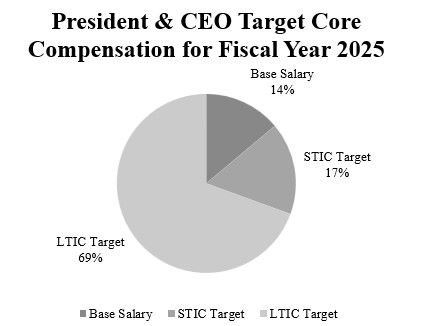
*
The approach used for compensation of our other Named Executive Officers is similar to that of our President and CEO, although the other executives generally have a higher percentage of base salary, and a
correspondingly lower percentage of STIC and LTIC.
|
2
|
This includes time-based restricted stock units, which the Compensation Committee considers to be “at risk” since the value fluctuates based on stock price performance and
vesting of all tranches is contingent upon continued service.
|
21
Factors Considered in Setting Compensation
The Compensation Committee continued to diligently apply the principles of our Executive Compensation Philosophy in setting compensation for our Named Executive Officers in fiscal 2025. Indeed, the Compensation
Committee considers and analyzes a number of factors when establishing and adjusting the elements of our executive compensation program and the compensation packages for the Named Executive Officers. The Compensation Committee strives to
establish compensation packages that enable the Company to attract, retain, and motivate the executive talent needed to operate the Company in a manner that is in the best interests of the shareholders.
The primary factors that the Compensation Committee considers are discussed below. They are not discussed in any order of priority, and no one factor standing alone determines the outcome or is necessarily
more important than the others.
Peer Group Data. The Compensation Committee compares the components and levels of our compensation program to those of
a selected peer group of companies. Our Compensation Committee believes that we have to remain competitive in comparison to our industry peers in order to attract, retain, and motivate our executive talent.
Our Compensation Committee benchmarks the target compensation of our Named Executive Officers to the 50th percentile of the compensation paid by our peer group, although actual compensation paid in any given
year may be above or below the benchmark, as a result of the performance-based nature of our executive compensation program and a variety of other factors that the Compensation Committee considers in setting compensation, including: level and
breadth of experience and responsibility of the officer; the complexity of the position; individual performance and growth potential; the difficulty of replacement; the individual’s tenure in his/her role; and internal equity.
The Compensation Committee reviews the composition of the Company’s peer group at least annually and, as appropriate, updates the group to reflect changes among peer companies, industry consolidation, and the
Company’s own evolution as a global pure-play industrial company. In considering our peer group, our Compensation Committee, aided by its independent compensation consultant, reviews various business attributes and financial metrics to
assess whether additions or deletions to the current peer group are appropriate. Qualitative factors considered in developing the peer group include the complexity of a company’s product line, extent of its global operations, and number of
business units. Quantitative factors include revenues, EBITDA, market capitalization, enterprise value, and number of employees, among others. In addition, various members of management provide input to the Compensation Committee relative
to understanding the Company’s key financial metrics, key competitors for talent, key competitors in the end markets we serve, the Company’s business plan, and other factors. Notwithstanding the above, decisions regarding the composition of
the peer group ultimately rest with the Compensation Committee.
At the start of fiscal 2025, the peer group in place, which was utilized to benchmark target compensation for our Named Executive Officers, consisted of the following 19 companies, as disclosed in the Company’s
2024 proxy statement:
|
Acuity Brands, Inc.
Barnes Group Inc.
Chart Industries, Inc.
Columbus McKinnon
Crane Co.
Donaldson Company, Inc.
Dover Corporation
ESAB Corporation
Fortive Corporation
IDEX Corporation
|
Itron, Inc.
ITT Inc.
John Bean Technology Corp.
Kennametal Inc.
Nordson Corporation
Regal Rexnord Corporation
The Middleby Corporation
The Timken Company
Woodward, Inc.
|
22
During fiscal 2025, the Compensation Committee conducted a review of the peer group and determined to add one new peer company and remove four peer companies, in order to better position the Company closer to
median revenue in the peer group and to reflect recent merger and go-private activity. As a result, the Compensation Committee added Graco to the peer group and removed Dover Corporation, Fortive Corporation, Regal Rexnord Corporation, and
Barnes Group Inc. from the peer group. Therefore, the peer group at the end of fiscal 2025 consisted of the following 16 companies:
|
Acuity Brands, Inc.
Chart Industries, Inc.
Crane Co.
Columbus McKinnon Corporation
Donaldson Company, Inc.
ESAB Corporation
Graco Inc.
IDEX Corporation
Itron, Inc.
|
ITT Inc.
John Bean Technology Corp.
Kennametal Inc.
Nordson Corporation
The Middleby Corporation
The Timken Company
Woodward, Inc.
|
Independent Compensation Consultant Expertise. The Compensation Committee engages an independent compensation consultant to provide
various items of relevant information and to perform various services in connection with the establishment of the elements of our executive compensation program. The Compensation Committee seeks and considers the expert advice and
recommendations of the independent compensation consultant in connection with the design of our compensation program and the establishment of appropriate compensation components and levels with respect to our Named Executive Officers. The
Compensation Committee retained Pay Governance as its independent compensation consultant for fiscal 2025.
The independent compensation consultant advises the Compensation Committee on an ongoing basis with regard to the general competitive landscape and trends in compensation matters, including (i) incentive plan
design, (ii) peer group selection and competitive market analyses, (iii) compensation risk management, and (iv) developments in emerging trends and practices. The consultant attends meetings of the Compensation Committee and at the request
of the Chairperson participates in its executive sessions.
See “Compensation Consultant Matters” in Part III below for additional information regarding the Compensation Committee’s engagement of Pay Governance as its compensation consultants in fiscal 2025.
Survey Data. In addition to peer group data, the Compensation Committee considers published compensation
survey data provided by its independent compensation consultant, focusing on compensation data for companies with revenues comparable to the Company’s revenue. The survey data supplements other factors considered in setting executive
compensation as a reference for market compensation levels and is targeted to the specific job responsibilities of our senior executives.
External Market Conditions. When establishing the total compensation of each Named Executive Officer, the
Compensation Committee also considers external market conditions, which include competitive pressures for the executive’s particular position within the industry, economic developments, and the condition of the labor markets.
Performance. Individual performance of our Named Executive Officers is evaluated in large part based upon
the achievement of collective and personal goals that are evaluated and established by management and approved by the Compensation Committee each year. The goals for fiscal 2025 are described below.
2025 Collective Performance Goals. Management identified and the Compensation Committee approved six common objectives for all of our Named Executive Officers for fiscal 2025. They were as follows:
| • |
Ensure successful operating company performance—provide oversight and resources needed to generate profitable organic and acquisition growth, strong cash flows, and improved return on invested capital.
This will be accomplished through the establishment of clear goals and objectives, appropriate oversight to ensure goal achievement, a transparent resource allocation process, a continued increase in the education, adoption, and
results expectations of the Hillenbrand Operating Model (“HOM”) for both manufacturing and commercial elements of the Company, and by driving innovative new product offerings.
|
23
| • |
Actively manage the Company’s portfolio to align with its strategy to build scalable platforms—identify prudent acquisition opportunities that meet our strategic criteria, provide attractive long-term
returns for shareholders, generate profitable revenue and earnings per share growth, and leverage the HOM. Ensure acquisition success by planning, executing, and integrating with excellence, focusing on the critical few key areas of
greatest value generation. Identify, plan, and execute other strategic alternatives as appropriate.
|
| • |
Accelerate our progress on developing a strong, deep, and diverse talent pool and building an inclusive culture aligned to our Purpose—play a leading role in continuing to embed Purpose and Core Values
throughout the organization and ensure the perspectives, experiences, and skill sets necessary to achieve the corporate strategy are present in the organization, especially in creating a more representative workforce. This will be
accomplished by creating an inclusive environment so that we can retain, attract, and develop top talent from within the Company and from the talent market.
|
| • |
Progress and execute on our efforts on sustainability activities—drive substantial improvement in our defined key metrics enterprise-wide on sustainability related initiatives to help drive sustainable
growth, value for our customers, developmental opportunities for our employees, and contributions to the communities in which we operate.
|
| • |
Continue to drive the implementation of the HOM—drive the foundation of the HOM across the enterprise, leveraging the framework to produce sustainable and predictable results across functions and
businesses. Enhance and teach the organization the fundamentals and management practices at the core of the HOM which include cost, productivity, integration, growth, innovation, and problem-solving practices.
|
| • |
Develop world class capabilities to support the Company’s strategy and projected growth—make certain that resources, processes, procedures, technology, and controls are aligned with the Company’s
transformation strategy. Establish high performing team and robust talent pipelines with appropriate experiences and skill sets to drive business continuity.
|
24
2025 Individual Performance Goals. Unique personal objectives were identified for each of the Named Executive Officers for fiscal 2025, as described below:
|
Name/Title
|
Goals
|
|||
|
Kimberly K. Ryan
|
Develop and execute the Company’s strategy and business plan and achieve the Company’s financial and operational objectives; allocate capital to create shareholder value; lead the
Company’s growth initiatives; oversee the Company’s acquisition and divestiture activities; champion the efforts focused on Diversity, Equity, and Inclusion and Sustainability initiatives designed to drive sustainable growth, value
for our customers, developmental opportunities for our associates, and contributions to the communities in which we operate; strengthen the talent pool, capabilities, and competencies of the Company; ensure that the Company engages in
appropriate, meaningful, and transparent conversations with key stakeholders; and continue to champion Purpose and Core Values.
|
|||
|
Robert M. VanHimbergen and Megan A. Walke, as interim CFO
|
Provide financial leadership with excellence to the Company and its subsidiaries; establish appropriate processes and procedures for the corporate financial function; ensure that appropriate
internal controls to safeguard financial assets and proprietary information are developed and maintained and there is adherence to accounting rules, including those recently adopted; employ a continuous improvement mindset and
activities throughout the finance function to increase efficiency, effectiveness, productivity, and quality; manage financial due diligence and integration efforts in the Company’s acquisition activities; lead all aspects of the Enterprise Risk Management (ERM) process in alignment with the strategy management process with focuses on early identification and mitigating action for
significant risks to the business.
|
|||
|
Aneesha Arora
|
Lead the enterprise HR strategy with a focus on strengthening organizational effectiveness, building the capabilities and skills of the Company, and providing an inclusive environment in which diverse
talent can excel; manage the succession planning process and ensure that talent pipelines have adequate bench strength across the enterprise; ensure competitive compensation and health and welfare benefit programs are in place to
attract and retain top talent; provide support and guidance around compliance programs working collaboratively with Legal; ensure appropriate HR processes and infrastructure are in place to drive a high performance culture; create and
execute on the long term digital HR transformation strategy of the organization.
|
|||
|
Nicholas R. Farrell
|
Provide legal counsel to the Company and its subsidiaries; ensure appropriate processes and procedures for the legal function are in place; oversee all securities and public company governance matters;
ensure appropriate compliance programs are in place and followed; manage legal due diligence efforts, transaction documentation, and integration in the Company’s acquisition activities; and manage all litigation involving the Company.
|
|||
|
Tamara Morytko
|
Develop and execute the strategy and operating plans of the Molding Technology Solutions (MTS) segment; grow revenue, EBITDA, and cash flow organically by penetrating growing end markets, driving
profitability improvements, accelerating geographic expansion, and driving improved technology and operational performance; oversee all innovation and new product development initiatives to enhance our competitive position; use HOM to
realize the full value of the MTS organization and to deliver sustainable and predictable results; identify strategic investments and targets to help to achieve the strategy of the business and achieve outpaced growth versus market.
Improve capability within the enterprise to enhance HOM adoption, results generation, sales, inventory, operations planning (SIOP), and materials management to ensure efficient use of working capital within the businesses.
|
Aggregate Compensation. The Compensation Committee considers the aggregate value of the Named Executive Officers’ core
compensation components of base salary and STIC and LTIC at target levels. The Compensation Committee compares the aggregate amount of these elements for our Named Executive Officers to the aggregate amount of the same elements of executive
officer compensation at other companies using peer group and survey data. The Compensation Committee generally targets total direct compensation levels at the median, including for new hires or promotions, but total pay opportunity levels
may vary above or below depending on experience level and other factors. For example, a newly hired executive with substantial experience may be provided with above median compensation, whereas a newly promoted executive from within the
Company may be targeted below the median due to their newness to the position. Additionally, the Compensation Committee periodically reviews “tally sheets” reflecting all compensation paid to our Named Executive Officers, including retirement
and other benefits and perquisites, and amounts potentially payable to them upon a “change in control” of the Company. The Compensation Committee also considers projections as to the potential future value of long-term equity awards made to
the Named Executive Officers.
25
Shareholder Say on Pay Vote. At each Annual Meeting of the Company’s shareholders since 2011, the Company has held a “Say on Pay Vote,” which is a non-binding advisory resolution stating that shareholders approve the compensation paid to the Company’s Named Executive Officers. The Compensation Committee carefully
considers the results of this vote each year. Company shareholders have approved the Say on Pay Vote with over 94 percent support each year for the past twelve years. The Compensation Committee believes that the historical level of support
for these votes reflects favorably on the Company’s executive compensation program and the actions taken by our Compensation Committee.
Compensation-Setting Process. Prior to or shortly after the start of each
fiscal year, our Compensation Committee and its consultant, as well as our President and CEO, take steps to establish that year’s compensation program and performance for the preceding fiscal year as shown in the table below. The discussion
that follows concerning compensation decisions regarding our Named Executive Officers for 2025 should be read with the understanding that Mr. VanHimbergen was Senior Vice President and CFO at the beginning of the fiscal year when the
Committee approved the compensation paid to our Named Executive Officers. Following Mr. VanHimbergen’s departure, Ms. Walke, the Company’s Vice President, Corporate Controller and Chief Accounting Officer was appointed as Interim CFO. Due
to Ms. Walke’s interim status as CFO, she generally participates in compensation and benefit programs applicable to executives at her leadership level which may differ from our other named executive officers.
|
Compensation Consultant`
|
Compensation Committee
|
|
Develops Executive Compensation Market Analysis (“ECMA”) that reports competitive compensation data using disclosures from the Company’s compensation peer group,
supplemented with data from industry-relevant, published compensation surveys.
|
Discusses the recommendations, reviews individual performance, and considers Company performance data and competitive benchmark information for all Named Executive Officers.
Solicits feedback from each director regarding the CEO’s performance during the prior year, with feedback based on CEO’s self-review and each director’s own independent evaluation.
Meets in executive session with the full Board without the CEO present to determine the CEO’s performance-based compensation for the current fiscal year and core compensation for the following fiscal
year.
Approves base salaries and target STIC and LTIC awards for all Named Executive Officers for the new fiscal year.
Determines the performance objectives of and the formula to calculate the STIC and LTIC awards for the new fiscal year, along with the LTIC award mix for all Named Executive Officers.
With support from the Company’s internal audit team, certifies performance for STIC and LTIC and confirms the computation of the actual STIC awards to be paid to the Named Executive Officers with
respect to the prior fiscal year.
|
|
President and CEO
|
|
|
Develops recommendations for Named Executive Officer compensation (other than her own) based on ECMA.
Develops self-review for her individual performance in the prior year.
|
The individual components of our Named Executive Officers’ 2025 compensation packages are described in further detail below.
26
Base Salaries. Our Named Executive Officers were paid the following base
salaries3 during the fiscal year ended September 30, 2025:
|
Name
|
Base Salary
|
|||
|
Kimberly K. Ryan
|
$
|
1,020,000
|
||
|
Robert M. VanHimbergen
|
$
|
435,708
|
||
|
Megan A. Walke
|
$
|
322,597
|
||
|
Aneesha Arora
|
$
|
519,973
|
||
|
Nicholas R. Farrell
|
$
|
583,524
|
||
|
Tamara Morytko
|
$
|
539,538
|
||
The Compensation Committee believes these salaries are appropriate in light of available comparative data and the total mix of compensation for each of these officers and necessary in order to provide a
guaranteed level of income to aid in the attraction and retention of talent in a competitive market.
The payment of annual cash STIC to our Named Executive Officers for fiscal 2025 was formula-based and governed by our Third Amended and Restated Short-Term Incentive Compensation Plan for Key Executives (“STIC Plan”). The STIC Plan is designed to motivate our Named Executive Officers to perform and to meet both collective and individual objectives, including to contribute to Company and, where applicable,
business unit performance goals, by providing for performance-based incentive compensation. To support this design, the STIC Plan contains provisions that specifically contemplate awards based on performance periods that may differ from our
fiscal year; permits the use of various award types, including discretionary bonuses; and provides authority to adjust performance goals or related achievement levels to reflect changes in business operations, corporate transactions, or
similar events. Our STIC Plan is consistent with our philosophy that employees should share in the Company’s success when our short-term financial objectives are achieved, as we believe such achievement ultimately results in creating value
for our shareholders. The potential to be paid short-term cash incentive awards plays an important role in the attraction and retention of our Named Executive Officers.
At the beginning of each fiscal year, the Compensation Committee approves each Named Executive Officer’s target STIC award. The target STIC award opportunities for our Named Executive Officers for 2025,
expressed as a percentage of annual base salary, remained unchanged from 2024 levels, other than an increase in Ms. Arora’s target STIC award opportunity to continue her transition to market median and to incentivize continued high
performance. These appear below.
|
Name
|
2025 Target
STIC
Opportunity
(as a % of base
salary)
|
|||
|
Kimberly K. Ryan
|
120% |
|
|
|
|
Robert M. VanHimbergen
|
75% |
|
|
|
|
Megan A. Walke
|
40% |
|
|
|
|
Aneesha Arora
|
65% |
|
|
|
|
Nicholas R. Farrell
|
70% |
|
|
|
|
Tamara Morytko
|
75% |
|
|
|
| 3 |
The salary amounts shown in this table vary slightly from those shown in the “Summary Compensation Table” in Part II below because this table reflects salary actually paid during the fiscal
year, while the “Summary Compensation Table” is presented based on salary earned during the fiscal year. The salary paid shown in this table is the
basis used for the annual STIC calculation described in this Amendment.
|
27
Our formula for calculating the STIC awards payable to our Named Executive Officers for fiscal 2025 was as follows:
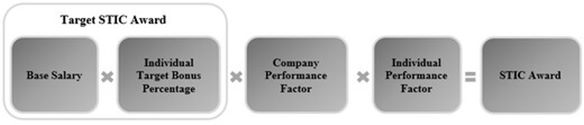
For fiscal 2025, the Company Performance Factor was based on achievement of designated levels of “Adjusted EBITDA,” “Net Revenue,”
and “Cash Conversion Cycle” (or CCC), each of which is further described in Part VI of this Item 11. These performance metrics translate to operational and financial performance, efficiency, and
sustainable improvement.
The financial performance targets under the STIC Plan for each of Hillenbrand and its applicable operating divisions, along with the actual results and payout levels,4 were as follows:
|
Hillenbrand
|
Weight
|
Threshold
|
Target
|
Maximum
|
Actual
Results
|
Payout
Level
|
||||||
|
Adjusted EBITDA5
|
50%
|
$354
|
$443
|
$509
|
$401
|
68.5%
|
||||||
|
Net Revenue
|
20%
|
$2,259
|
$2,824
|
$3,050
|
$2,496
|
61.4%
|
||||||
|
CCC
|
30%
|
83.0 Days
|
69.2 Days
|
55.4 Days
|
68.3 Days
|
91.3%
|
||||||
|
Company Performance Factor for Hillenbrand (Consolidated)
|
73.9% | |||||||||||
The Compensation Committee periodically evaluates the appropriateness of individual STIC components and makes changes as warranted, particularly in connection with any significant changes to the Company’s
business or portfolio. In an effort to align the program to more appropriately reflect the nature of the Company’s business and portfolio, for fiscal 2025, the Compensation Committee determined to lower the threshold for Revenue to a 33
1/3% payout for 80% achievement of the target (from a 50% payout for 90% achievement of the target in fiscal 2024). In addition, for fiscal 2025 the Compensation Committee determined to increase the weight of the CCC component from 25% to
30%, while correspondingly decreasing the weight of the Revenue/OI component from 25% to 20% in order to reflect the Company’s focus on cash generation.
The following table shows the fiscal 2025 performance and payout curves:
|
Threshold
|
Target
|
Maximum
|
|||
|
Adjusted EBITDA
|
33 1/3%
|
100%
|
200%
|
||
|
Revenue/Order Intake
|
33 1/3%
|
100%
|
200%
|
||
|
CCC
|
50%
|
100%
|
200%
|
The definitions for each of the STIC performance metrics are set forth in Part VI of this Item 11.
| 4 |
As part of the annual compensation setting process, the Compensation Committee translates percentage achievement of each STIC component into the payout levels used to arrive at the overall Company Performance Factor. Adjusted
EBITDA, and Net Revenue are shown in millions.
|
|
5
|
Adjusted EBITDA at the Hillenbrand level reflects the impact of the full amount of corporate overhead costs for the enterprise.
|
28
The final results for these performance metrics are used to calculate the Company Performance Factor at the end of the applicable performance period. After the end of the fiscal year, the Compensation
Committee assigns an Individual Performance Factor to each Named Executive Officer, with the exception of the CEO, based on its review of the CEO’s assessment of the officer’s performance during the performance period, including performance
relative to his or her individual and collective objectives described above under the heading “Factors Considered in Setting Compensation.” For the CEO, the Board assigns the Individual Performance Factor based on its review of the CEO’s
performance and self-assessment for the performance period, including the factors described above. For fiscal 2025, these reviews were conducted following the end of the fiscal year. The Individual Performance Factor can range from 1.0x
at target performance, to 1.2x for superior performance, and below 1.0x if target levels have not been achieved.
For fiscal 2025, STIC awards for our Named Executive Officers were calculated as described above, and the Compensation Committee certified performance and confirmed the following calculation:
|
Name
|
Target STIC
Award6
|
Applicable
Company
Performance
Factor
|
Individual
Performance
Factor
|
Total
STIC
Award
Paid
|
||||||||||||
|
Kimberly K. Ryan
|
$
|
1,224,000
|
73.9
|
%
|
100
|
%
|
$
|
949,763
|
||||||||
|
Robert M. VanHimbergen7
|
$
|
314,762
|
73.9
|
%
|
n/a
|
$
|
—
|
|||||||||
|
Megan A. Walke
|
$
|
129,039
|
73.9
|
%
|
120
|
%
|
$
|
114,987
|
||||||||
|
Aneesha Arora
|
$
|
337,982
|
73.9
|
%
|
115
|
%
|
$
|
287,581
|
||||||||
|
Nicholas R. Farrell
|
$
|
408,467
|
73.9
|
%
|
115
|
%
|
$
|
347,443
|
||||||||
|
Tamara Morytko
|
$
|
404,654
|
73.9
|
%
|
110
|
%
|
$
|
329,235
|
||||||||
As described above, the Company’s annual STIC program is designed to motivate our Named Executive Officers to perform and is the primary vehicle for performance-based cash compensation. But when advisable
under the circumstances, the Compensation Committee may consider additional compensation for certain key executives. In fiscal 2025, prior to the departure of the Mr. VanHimbergen, the Company’s former Chief Financial Officer, the
Compensation Committee approved a one-time cash retention award of $100,000 for Ms. Walke in her capacity as Vice President, Corporate Controller and Chief Accounting Officer, given the essential role of the finance function and to support
retention and business continuity during an anticipated finance leadership transition. In approving this award, the Compensation Committee also considered Ms. Walke’s skills and experience, sustained high performance, and tenure with the
Company. The award was granted during fiscal 2025, is subject to continued service through the end of fiscal 2026 and is payable upon satisfaction of this retention condition.
Long-Term Incentive Compensation
Overview. We provide LTIC to our Named Executive Officers and other employees by awarding them a combination of time-based restricted stock units (“RSUs”) and performance-based RSUs. In setting the amount of each annual LTIC award granted to our Named Executive Officers, the Compensation Committee bases its decision on comparative data from the
Company’s compensation peer group and applicable survey data, benchmarked at the 50th percentile, while aiming to encourage high performance, resulting in the LTIC awards set forth below.
| 6 |
The target STIC award is calculated as base salary earnings times the individual’s target bonus percentage; the calculation uses salary amounts that vary slightly from those shown in the “Summary Compensation Table” in Part III
below because that table is presented based on salary earned during the fiscal year, while fiscal 2025 STIC awards are calculated based on salary actually paid.
|
|
7
|
In connection with his resignation during the year, Mr. VanHimbergen was not paid a STIC award for fiscal year 2025.
|
29
|
Name
|
2024 LTIC
Opportunity
|
2025 LTIC
Opportunity
|
||||||
|
Kimberly K. Ryan
|
$
|
4,850,000
|
$
|
5,100,000
|
||||
|
Robert M. VanHimbergen
|
$
|
1,364,000
|
$
|
1,464,000
|
||||
|
Megan A. Walke
|
$
|
124,000
|
$
|
124,000
|
||||
|
Aneesha Arora
|
$
|
675,000
|
$
|
700,000
|
||||
|
Nicholas R. Farrell
|
$
|
750,000
|
$
|
750,000
|
||||
|
Tamara Morytko
|
$
|
800,000
|
$
|
850,000
|
||||
The Compensation Committee then allocated the 2025 LTIC award opportunity to performance-based and time-based RSUs as follows, except that Ms. Walke’s award reflected the allocation applicable to her
leadership level rather than the allocation applicable to other Named Executive Officers8:
|
Award Type
|
Allocation of
LTIC Award
Value
|
Brief Description
of Award Type
|
||
|
Performance-Based RSUs
|
2/3
|
Performance measured over a three-year period commencing October 1, 2024
Split equally between:
(1) awards
that vest based on our shareholder value formula (“Shareholder Value RSUs”), and
(2) awards
that vest based on our relative total shareholder return (“TSR”) formula (“Relative TSR RSUs”)
|
||
|
Time-Based RSUs
|
1/3
|
Number of RSUs set based on fair market value on date of award; vest over a three-year period
|
We believe that by linking a significant portion of the pay of our Named Executive Officers to the achievement of targets over three years, our LTIC program shapes investment strategies that improve the
Company’s value over the long term. At times over the course of the Company’s history, actual achievement levels have resulted in payouts of our various performance-based equity awards that cover nearly the full range of performance,
between no payout (zero percent) to close to the maximum payout of 175 percent for historical awards. Beginning with awards granted during fiscal 2023, the maximum payout for Shareholder Value RSUs and Relative TSR RSUs was changed from
175 to 200 percent. The Compensation Committee made this change after assessing our executive compensation program in comparison to peers, survey data, and other factors. The change aligned with recommendations made by the Committee’s
independent compensation consultant, as part of an effort to continue to incentivize executives to exceed target levels of performance, and for the Company to remain in general alignment with the market for executive talent.
In general, the Company’s annual performance-based RSU payouts have ranged from approximately 40 percent to approximately 120 percent of the targeted amount, with only a few years falling above or below that
range. As a result, we believe the Company’s LTIC award structure and overall program reflect appropriate stretch goals for each business cycle.
|
8
|
For fiscal 2025, Ms. Walke’s LTIC award opportunity was allocated two-thirds to time-based RSUs and one-third to performance-based RSUs, split equally between Shareholder Value RSUs and Relative
TSR RSUs.
|
30
Compared to the average of our compensation peer group’s mix of LTIC awards, our annual LTIC grants to Named Executive Officers in fiscal 2025 were generally aligned, but included a heavier emphasis on
performance-based awards, as shown in the table below.
|
Peer Group Average
in Fiscal 2025* |
Hillenbrand, Inc.
in Fiscal 2025 |
|
|
Performance Shares/Units
|
53%
|
67%
|
|
Time-Based Shares/Units
|
25%
|
33%
|
|
Time-Based Stock Options or Stock Appreciation Rights
|
22%
|
—
|
* Source: Proxy filings
Shareholder Value RSUs. The Shareholder Value RSUs granted in fiscal 2025 are earned based on the actual shareholder value created during the three-year period commencing
October 1, 2024 (referred to as “Shareholder Value Delivered”) above or below what was expected during that same period (referred to as “Shareholder Value Expected”),
as further described in Part VI of this Item 11. The amount of Shareholder Value Expected as of the end of the three-year measurement period is $4,828.2 million, reflecting the targeted amount of economic value at the end of the three
years ending on September 30, 2027, subject to certain adjustments as described below and in Part VI of this Item 11.
At the end of the three-year measurement period the Shareholder Value RSUs will vest in an amount equal to the product of (i) the target number of shares, times (ii) a multiplier based on the ratio, expressed
as a percentage, of Shareholder Value Delivered to Shareholder Value Expected as follows (achievement between the points is interpolated linearly to calculate the corresponding multiplier):
|
Shareholder Value Delivered
as Percentage of
Shareholder Value Expected
|
Multiplier
|
|
|
Less than 70%
|
zero (no units earned)
|
|
|
At least 70%
|
0.25 (minimum number of units earned)
|
|
|
100%
|
1.00 (target number of units earned)
|
|
|
At least 130%
|
2.00 (maximum number of units earned)
|
31
The achievement levels and corresponding multipliers set forth above are expressed in further detail in the payout curve set forth below.
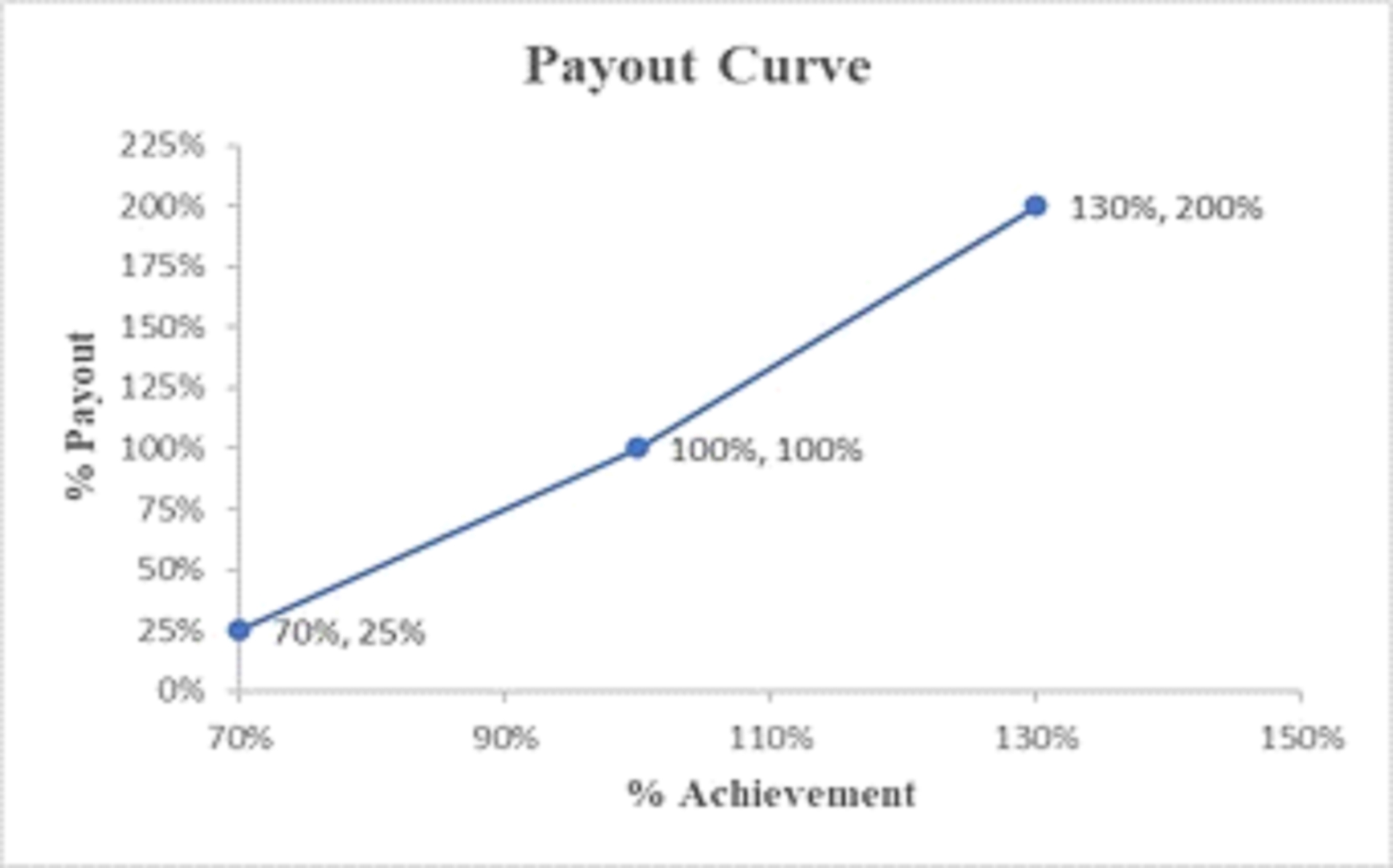
The Compensation Committee has determined that dividend equivalent amounts are accrued on Shareholder Value RSUs during the measurement period as dividends are declared on the Company’s common stock. These
equivalent amounts are deemed to be reinvested in additional shares of Company common stock and then ultimately paid in the form of additional shares when the underlying award vests, using the same multiplier as the underlying award.
Our formula for calculating the shareholder value components of these awards is a discounted cash flow model that is designed to reflect the true economic return to investors. The key inputs into the model
are:
| • |
the Company’s net operating profit after tax, which is calculated by taking net income and adding back certain unusual and/or infrequent non-cash items (“NOPAT”);
|
| • |
free cash flow; and
|
| • |
the established “hurdle rate,” which is a reflection of the Company’s enterprise-wide weighted average cost of capital and targeted capital structure (the “Hurdle Rate”).
|
It is contemplated that the Hurdle Rate will typically equal or exceed the Company’s weighted average cost of capital. In general, the Shareholder Value RSUs are designed to pay on the basis of the growth in
economic value to an investor over three years, and the Company must earn a return that meets the applicable Hurdle Rate in order for a Named Executive Officer to earn the targeted award. The return must exceed the Hurdle Rate to exceed
the targeted award. We believe that linking the pay of our Named Executive Officers with the growth in the economic value of the Company in this way aligns the interests of the executive management team with those of the Company’s
shareholders.
Calculation of Shareholder Value Expected. The amount of Shareholder Value Expected as of the end of a measurement period is generally
calculated as (i) the Company’s Adjusted NOPAT (defined in Part VI of this Item 11) for the prior fiscal year, (ii) divided by the Hurdle Rate, and (iii) multiplied by the cube of (1 + Hurdle Rate), with certain limited exceptions set forth
in Part VI of this Item 11:

The Compensation Committee makes adjustments for divestitures during the course of the performance period of these awards. During the performance period ending with fiscal 2025, the Company divested its
Milacron injection molding business. For this divestiture, the Compensation Committee adjusted the applicable targets to align with the respective partial ownership periods. Similarly, the Compensation Committee has in the past adjusted
award calculations to include newly acquired businesses. In order to simplify calculations of such targets and reduce the likelihood of distortive effects on compensation, whether positive or negative, the Compensation Committee
determined, beginning with awards made in fiscal 2021, not to adjust such awards for the impact of any acquisitions made during the performance period.
32
The foregoing adjustments, along with any described in the definitions set forth in Part VI of this Item 11, are not intended to be comprehensive, and the Compensation Committee retains discretion to make
additional adjustments consistent with the terms of the Stock Plan and awards thereunder.
Calculation of Shareholder Value Delivered. The amount of Shareholder Value Delivered as of the end of a measurement period is
calculated by adding two components: the Ending NOPAT Component and the Ending Cash Flow Component. See Part VI of this Item 11 for applicable definitions.
Relative TSR RSUs. The Relative TSR RSUs granted in fiscal 2025 are earned based on the change in the market price of the Company’s common stock during the three-year
period commencing October 1, 2024, compared to the change in market price of the stock of the members of the Standard & Poor’s 400 Mid Cap Industrials index (referred to herein as the “Index Companies”)
during that same period, taking dividends into account as further described below. By linking the pay of our Named Executive Officers with the relative return earned by our shareholders compared to our peers, the Relative TSR RSUs create
an incentive for our executive management team to produce above market returns for our shareholders.
Whereas dividends accrue during the measurement period with respect to shares underlying the Shareholder Value RSUs as described above, the Compensation Committee has determined that dividends do not accrue
during the measurement period with respect to shares underlying Relative TSR RSUs, and as a result the determination of the grant date value of the Relative TSR RSUs assumes no dividends are paid on these shares.
For the awards made in fiscal 2025 and vesting at the end of fiscal 2027, the Compensation Committee used a payout formula for Relative TSR RSUs that provides a 25 percent of target minimum payout for
achievement at the 25th percentile, 100 percent of target payout at 50th percentile achievement, and 200 percent of target payout at 75th percentile achievement and above. Performance below the 25th percentile earns a zero payout. The
formula uses linear interpolation for payouts between the 25th and 75th percentiles, and the Company’s relative TSR must be achieved at median to receive the target payout.
The key inputs and award calculation formula for these Relative TSR RSU awards are the Beginning Average Price and Ending Average Price of the stock of the Company and the Index Companies, as applicable; the
Dividend Reinvestment Multiplier applicable to each such company; and the TSR of each such company during the measurement period. Definitions of these terms are set forth in Part VI of this Item 11. The TSR of the Company and each of the
Index Companies during the measurement period is calculated by subtracting one from the quotient of (i) the Ending Average Price for that company, divided by (ii) the Beginning Average Price for that company, as shown below.

Vesting of Fiscal 2023 LTIC Awards. On September 30, 2025, the three-year measurement period for the Company’s LTIC awards that were granted in fiscal 2023 closed. Those
awards vested in accordance with our two performance-based LTIC award formulas described above. During the three-year measurement period (fiscal years 2023-2025), the Company achieved an actual shareholder value increase equal to 82
percent of the target for that measurement period, resulting in a vested award amount equal to 55 percent of the targeted number of shares (i.e., the number of shares that would be earned upon
achievement in full of the target shareholder value increase).
33
Under the relative TSR formula, at the end of the three-year measurement period, the Company ranked at the 10th percentile of the Index Companies constituted as of the date of the award, resulting in a payout at 0% percent of target.
Additional details regarding the LTIC awards granted in fiscal 2023 are set forth under the heading “Long-Term Incentive Compensation” in the “Compensation Discussion and Analysis” section of our proxy statement for our 2024 Annual
Meeting of shareholders that was filed with the SEC on January 9, 2024. See the “Option Exercises and Stock Vested for Fiscal Year Ended September 30, 2025” table in Part II below for additional detail regarding the vesting of the LTIC
awards granted in fiscal 2023.
Time-Based RSUs. The grants of annual time-based RSUs awarded in fiscal 2025 vest ratably on the first, second, and third anniversaries of the grant date (one-third on
each grant date anniversary). The Compensation Committee has determined that dividend equivalent amounts are accrued on unvested time-based RSUs during the vesting period as dividends are declared on the Company’s common stock. Dividends
paid on the Company common stock are accrued and deemed to be reinvested in Company common stock at the market value on the date of such dividend, and paid in additional shares on the vesting date of the underlying award in proportion to
the number of shares that vest.
Non-recurring Awards in Fiscal 2025. Also, in fiscal 2025, amid market uncertainty and in response to identified retention considerations, the Compensation Committee
determined that providing retention awards to Megan Walke, the Company’s Vice President, Corporate Controller, Chief Accounting Officer and Interim CFO, Aneesha Arora, the Company’s Senior Vice President and Chief Human Resources Officer,
Nicholas Farrell, the Company’s Senior Vice President, General Counsel and Secretary, and Tamara Morytko, the Company’s Senior Vice President and Group President, was appropriate, as the departure of any of these senior executives could
have had a significant adverse impact on the Company’s business and financial results. Accordingly, the Compensation Committee approved the grant of non-recurring retention awards to these executives, structured with the same mix of
time-based and performance-based RSUs and subject to the same vesting schedule as their annual equity award. These awards were granted to Ms. Arora, Mr. Farrell, and Ms. Morytko with a total grant date value of approximately $240,000 and
to Ms. Walke with a total grant date value of approximately $40,000.
Executive Share Match. In fiscal 2024, the Compensation Committee adopted a framework by which certain executives, including the Named Executive Officers, with the
exception of Ms. Walke, may receive a share match from the Company from time to time and under certain circumstances (previously disclosed in the Company’s Quarterly Report on Form 10-Q for the quarter ended June 30, 2024). For fiscal
2025, matching common stock shares were issued in March 2025 at the end of an acquisition period established by the Compensation Committee. For fiscal 2026, additional matching shares were issued at the end of a second acquisition period
in October 2025. No subsequent acquisition period commenced following the end of the second acquisition period in October 2025. The purpose of this framework was to provide an opportunity for senior executives to increase their investment
in the Company’s common stock in order to further align their interests with those of the Company’s shareholders and to encourage their long-term retention with the Company. The Executive Matching Shares Program will terminate upon the
closing of the Company’s merger.
Treatment of Long-Term Incentives in the Merger. In connection with, and subject to the closing of the transactions contemplated by the Agreement and Plan of Merger, dated as of October 14, 2025, by
and among the Company, LSF12 Helix Parent, LLC and LSF12 Helix Merger Sub, Inc., at the effective time of the merger, each outstanding option to purchase shares of Company common stock granted pursuant to any Company equity incentive plan
(a “Company Option”), each outstanding time-based RSU that was granted on or prior to October 14, 2025, or to a non-employee member of the Board of Directors at any time, each outstanding vested deferred share granted or deemed purchased
pursuant to a Company equity incentive or deferred compensation plan (each, a “Company Restricted Stock Unit”) and each outstanding performance-based RSU granted pursuant to a Company equity incentive plan will vest in full and be cashed
out at a price per share of $32.00, less any required tax withholding and, in the case of a Company Option, less the applicable per share exercise price, with the number of shares of Company common stock subject to each performance-based
RSU determined by deeming the applicable performance goals to be achieved at the greater of the target level of performance or the actual level of performance measured through the date immediately prior to the Effective Time (or as close to
such date as administratively practicable, as determined by the Company), with such performance determined in good faith by the Board or a duly authorized committee or subcommittee thereof in accordance with the terms of the applicable
award agreements.
34
Company Options with a per share exercise price that is equal to or greater than $32.00 will be canceled for no consideration. Each RSU granted after October 14, 2025 (other than any such awards granted to a non-employee member of the
Board) that is outstanding at the effective time of the merger will convert into a cash award (a “Restricted Cash Award”) with a value equal to $32.00 per share of Company common stock underlying the RSU. Each Restricted Cash Award will
be subject to the same terms and conditions as those that applied to the RSU that was converted into such Restricted Cash Award.
Savings Plans. We maintain a tax-qualified defined contribution savings plan (the “Savings
Plan”) in which most of our U.S.-domiciled employees, including all of the Named Executive Officers are eligible to participate. The employees participating in the Savings Plan may contribute a percentage of their compensation
thereto on a pre-tax or Roth after-tax basis, subject to applicable limits. For the Savings Plan, the Company matches contributions for all eligible employees, which includes all of the Named Executive Officers. Additionally, whether or
not employees eligible to contribute to the Savings Plan did so, the Company provided an automatic contribution per pay period to the Savings Plan. All contributions by employees and the automatic Company contribution are fully vested
immediately, but the Company matching contributions historically did not vest until after three years of credited service, at which point further Company matching contributions vested immediately when made. In addition, an employee’s
actual annual cash bonus amount historically was excluded as compensation from the contribution formula under the plan. Beginning in 2021, however, all contributions, including Company matching contributions, vested immediately when made,
and actual annual cash bonus amount began to be included as compensation (in addition to base salary) for calculating contributions.
For information regarding compensation paid to our Named Executive Officers under the Savings Plan, see footnote 5 to the “Summary Compensation Table” in Part II below.
Supplemental Retirement Plan. We maintain a Supplemental Retirement Plan administered by Fidelity Management Trust
Company (the “SRP”) that provides a defined contribution benefit to plan participants. Our Named Executive Officers, except for Ms. Walke, participate in the SRP. The SRP is designed to supplement
the amount of retirement benefits that participants are entitled to receive from our Savings Plan.
The Internal Revenue Code establishes certain limits with respect to tax-qualified retirement plans like our Savings Plan, including a limit on the maximum amount of compensation that can be counted as
earnings of the participant for purposes of calculating benefits. The application of these tax law limits can reduce the amount that would otherwise be payable to a participant under the terms of a tax-qualified retirement plan. In
general, the SRP is designed to “make whole” a participant by paying benefits otherwise lost under the Savings Plan due to the application of tax law limits from the plan’s contribution formula. The SRP annually accrues future benefits for
the participants equal to the difference between (i) the benefit amount that is actually contributed for a participant under the Savings Plan, and (ii) the amount that would have been contributed if the tax law limits were not applied.
Once benefits under the SRP have vested, they are generally payable following retirement or termination of employment. However, if a participant’s employment is terminated for “cause” (as such term is
defined in the SRP), contributions under the SRP may be forfeited.
Under the SRP, participants are permitted to direct the investment of their accrued accounts (on a hypothetical basis because this is non-cash “shadow” deferred compensation) into various Fidelity mutual
funds. The Company then actually makes those designated investments for the Company’s own account with funds contributed by the Company under a “Rabbi Trust” arrangement. The SRP also permits a
participant, when permitted by Section 409A of the U.S. Internal Revenue Code, to elect to defer all or a portion of his or her annual cash bonus for payment at a later time and to invest the deferred amounts in Fidelity mutual funds on a
hypothetical basis.
For information concerning benefits payable to our Named Executive Officers under the SRP, see the table entitled “Nonqualified Deferred Compensation for Fiscal Year Ended September 30, 2025” in Part II
below.
None of our Named Executive Officers participates in or has account balances in any non-qualified defined benefit plan sponsored by us.
35
Employment Agreements. We have entered into employment agreements with each of our Named Executive Officers, except
for Ms. Walke9. We believe that it is appropriate for our senior executives to have employment agreements because they provide the Company certain contractual
protections that we might not otherwise have, including provisions relating to not competing with us, not soliciting our employees, and maintaining the confidentiality of our proprietary information. The employment agreements we have with
our Named Executive Officers contain non-competition and non-solicitation agreements that generally continue in effect for a period of one to two years after the termination of the Named Executive Officer’s employment. Additionally, we
believe that employment agreements are a useful tool in the recruiting and retention of senior-level executives. The employment agreements are substantially similar among our Named Executive Officers other than as described for our Chief
Executive Officer and Ms. Walke.
Termination Benefits Under Employment Agreements with Named Executive Officers. The employment agreements in place with our Named Executive Officers provide for employment “at will.” They are
terminable by the Named Executive Officer without “cause” or without “good reason” on 60 days’ written notice, by the Company at any time without “cause,” and also by the Company at any time (subject to certain cure rights) for “cause,” as
such term is defined in each employment agreement. These Named Executive Officers with employment agreements are also entitled to terminate their employment agreements for “good reason,” as such term is defined in their agreements. If we
terminate the employment of a Named Executive Officer with an employment agreement without “cause,” or if his or her employment is terminated with “good reason,” then we are obligated to provide severance compensation in connection with
such termination. No severance compensation is payable under our employment agreements with our Named Executive Officers if we terminate with “cause,” if the executive terminates without “good reason,” or if the employment relationship is
terminated on account of death or disability.
If the employment of a Named Executive Officer with an employment agreement is terminated by the Company without cause or is terminated by the executive officer upon the occurrence, without the executive
officer’s consent, of a good reason event, we are required under the officer’s employment agreement to provide severance compensation to such Named Executive Officer as follows:
| • |
continuation of the officer’s base salary for 12 months (24 months for Ms. Ryan as CEO), subject to required tax withholdings, which payments may need to be delayed for six months under certain
provisions of the Internal Revenue Code;
|
| • |
continued health coverage and, in some cases, group life insurance, until the continuation of base salary period described above is complete; and
|
| • |
limited out-placement counseling.
|
Post-Termination Payments of STIC and LTIC. A Named Executive Officer whose employment terminates may or may not be
entitled to the post-termination payment of all or a pro rata portion of the STIC or LTIC award that would have been payable to the Named Executive Officer if his or her employment had continued through the end of the applicable measurement
period. The amount payable, if any, depends on the performance of the Company or its applicable business unit throughout the measurement period in question and the circumstances under which employment terminates.
STIC. Post-termination STIC is payable to a Named Executive Officer after the performance period in question has ended and only if it is determined under the applicable
performance formula that an amount would have been payable to the former officer had his or her employment continued through the end of the performance period. The amount, if any, that is payable depends upon the circumstances of the
termination. If employment terminates due to death, disability, retirement (after age 55 and five years of service), involuntary termination without “cause,” or voluntary termination for “good reason,” then the former officer is entitled to
a pro rata payment of his or her STIC award based on the portion of the fiscal year during which he or she remained employed, subject to a reduction of that amount at the discretion of the Compensation Committee. No pro rata STIC is
payable to officers upon an involuntary termination with cause or a voluntary termination without good reason.
|
9
|
As interim CFO, Ms. Walke does not have an executive officer employment agreement with the Company. In the event of a termination in connection with a restructuring or position elimination, she
would be eligible to receive severance benefits consistent with the Company’s policy for executives at her leadership level, consisting of up to six months of base salary continuation, continued medical benefits at active
employee rates for up to six months, and outplacement services, subject to the execution of a release of claims.
|
36
LTIC. Following termination, the performance-based portion of an LTIC award is payable to a Named Executive Officer only after the measurement period in question has
ended and only if it is determined under the applicable performance formula that an amount would have been payable to the former officer had his or her employment continued through the end of the measurement period. Once the amount that
would have been paid had employment continued (the “Full Period Award”) is determined, if employment terminates due to death, disability, or retirement (after age 55 and five years of service),
involuntarily without cause, or voluntarily for “good reason,” the Named Executive Officer is entitled to a pro rata amount of the Full Period Award based on the portion of the measurement period during which he or she remained employed,
and in any other circumstance, all outstanding performance-based RSUs are forfeited upon termination of employment.
Following termination, any unvested portion of a Named Executive Officer’s annual time-based RSUs are forfeited except as follows:
| • |
if employment terminates due to death or disability after one year and one day following the grant date, all unvested shares shall become vested shares; and
|
| • |
if employment terminates due to retirement (as defined above), voluntarily by the executive for “good reason” pursuant to an employment agreement, or involuntarily by the Company without cause, the
Named Executive Officer will receive prorated vesting.
|
In any other circumstance, all unvested shares of time-based RSUs are forfeited upon termination of employment.
For both performance- and time-based RSUs, vesting upon a change in control is governed by the terms of the Stock Plan and any applicable change in control agreement, as discussed further below.
For more information regarding the severance benefits payable to our Named Executive Officers under their employment agreements and our STIC and LTIC compensation programs, see the tables under the heading
“Potential Payments Upon Termination” in Part II below.
Change in Control Agreements. We believe it is important that management be in a position to provide an objective
assessment and advice to the Company’s Board of Directors regarding any proposed business transaction without being unduly distracted by the uncertainties and risks that a proposed change in control of the Company creates with respect to
management. Accordingly, we have change in control agreements with each of our Named Executive Officers and other key executives that provide compensation to the executive if his or her employment is terminated in connection with a change
in control of the Company. The compensation provided under these agreements is in lieu of severance compensation provided under that executive’s employment agreement.
These change in control agreements provide for payment of benefits only upon a termination of employment in anticipation of or within two years after the occurrence of a change in control (a “double
trigger”), but excluding terminations on account of death or disability or for “cause” or by the executive without good reason (a “Qualified Termination”). These change in control agreements
expressly supersede the Company’s Stock Plan, which provides for single-trigger vesting of equity awards.
Under the change in control agreements, the benefits to be provided upon a Qualified Termination include:
| • |
a lump sum payment in cash equal to two times the executive’s annual base salary and two times target STIC (three times for the CEO);
|
| • |
continued health insurance for the executive and his or her dependents for 24 months (36 months for the CEO), with the right to purchase continued medical insurance (at COBRA rates) from the end of
this period until the executive reaches Social Security retirement age;
|
37
| • |
a lump sum payment equal to his or her respective pro rata current year STIC award, assuming the greater of target or actual achievement in that year of the relevant performance targets under the STIC
Plan, prorated through the date of termination of employment; and
|
| • |
immediate vesting of all outstanding stock options and equity awards, assuming (where applicable) (i) the greater of target or actual achievement of the relevant performance goals.
|
These rights and benefits are subject to certain customary non-competition obligations, with a non-competition period that matches the applicable severance period of two or three years, and are contingent
upon the execution of a release. In addition, the rights and benefits provided in the change in control agreements are not subject to tax gross-ups. If an executive is entitled to receive payments upon a change in control that may be
subject to the excise tax, he or she will either be paid the full amount (and remain personally liable for the excise tax) or be paid a reduced amount that does not give rise to the excise tax, whichever is greater on an after-tax basis.
Under the change in control agreements, a “change in control” is defined in conformance with the Stock Plan as: (i) the acquisition of beneficial ownership of 35 percent or more of the voting power of all of
the Company’s voting securities by a person or group; (ii) the consummation of certain mergers or consolidations; (iii) a change in the composition of a majority of the members of the Company’s Board of Directors; (iv) the consummation of a
sale of substantially all of the Company’s assets (i.e., 50 percent or more of the assets) in one or a series of transactions within any period of 12 consecutive months; or (v) the approval by the
Company’s shareholders of a plan of complete liquidation of the Company.
The amounts potentially payable to our Named Executive Officers in connection with a change in control are set forth in the tables under the headings “Potential Payments Upon Termination” and “Change in
Control Benefits” in Part II below.
In addition to the compensation components discussed above, we also provide our Named Executive Officers, as well as certain other U.S.-based employees and officers, with other benefits as described below.
We generally disfavor providing extensive perquisites but do provide modest benefits intended to enhance the effectiveness of our Named Executive Officers and complement the highly variable, performance-oriented compensation components we
utilize. We also provide these benefits in order to remain competitive with the market and believe that these benefits help us to attract and retain qualified executives.
Executive Financial Planning, Estate Planning, and Tax Preparation Service Program. Our Named Executive Officers and
certain other officers are eligible for limited reimbursement of (i) financial and estate planning services and (ii) income tax preparation services. Reimbursement is approved for up to $10,000 per calendar year.
Executive Physical. We provide our Named Executive Officers and certain other officers with the opportunity to
receive executive annual physicals. We cover 100 percent of the cost of this program for officers who see the Company’s selected provider or reimburse an equivalent amount for any officer who selects his or her own provider. This program
was developed to promote the physical well-being and health of our senior-level managers. We believe that this program is in the best long-term interests of our shareholders.
Other Benefits. Our Named Executive Officers also participate in other benefit plans that we fully or partially
subsidize. Their participation is generally on the same terms as other employees. Some of the more significant of these benefits include medical, dental, life, disability, and vision insurance, as well as relocation reimbursement, tuition
reimbursement, and holiday and vacation benefits. Many employees, including all of our Named Executive Officers, participate in our group term life insurance program, which in the past provided death benefit coverage of up to one and
one-half times base salary or $500,000, whichever is less. Beginning in calendar year 2025, the death benefit coverage for our Named Executive Officers increased to two times base salary or $1,000,000, whichever is less. In addition, our
Named Executive Officers and certain other employees are eligible to participate in our optional supplemental group term life insurance program, in which participants may purchase additional term life insurance at their own expense in
amounts up to the lesser of five times base annual salary or $600,000. Furthermore, in certain cases, our Named Executive Officers may receive supplemental long-term disability premiums paid by the Company and other modest personal
benefits as set forth in the footnotes to the Summary Compensation Table below.
|
10
|
As interim CFO, Ms. Walke does not participate in these benefit and perquisite programs. She participates in our group term life insurance and additional life insurance program, but not the
expanded coverage available for other named executive officers.
|
38
In connection with the Company’s compensation program, we have established certain policies that relate to executive compensation. The most significant of these policies are described below.
Stock Ownership Requirement. All of our Named Executive Officers, as well as certain other officers, are required to
own a significant number of shares of Company common stock. Specifically, the officers identified below, from and after the fifth anniversary of the date on which such individual first became such an officer, or, in the case of a
promotion, from and after the third anniversary of becoming subject to a higher Required Ownership Level, are required to hold shares of our common stock or equivalents (as further described below) with a minimum aggregate value at the
following levels (“Required Ownership Level”):
|
Position
|
Required Ownership Level
|
|
|
Chief Executive Officer of the Company
|
5 x Base Annual Salary
|
|
|
Senior Vice Presidents of the Company
|
2 x Base Annual Salary
|
|
|
Certain senior officers of the Company and its subsidiaries as designated by the Company Chief Executive Officer from time to time
|
1 x Base Annual Salary
|
Each of our Named Executive Officers currently holds shares of our common stock or stock equivalents at levels greater than or equal to their Required Ownership Level. Ms. Walke and Ms. Morytko are under the
five-year compliance deadline. Shares owned outright and shares represented by RSUs or restricted stock awards, whether vested or unvested, excluding performance-based shares, count as share equivalents toward the Required Ownership
Level. Unexercised stock options do not count toward the Required Ownership Level.
Failure to achieve or maintain the Required Ownership Level may result in (i) the applicable individual being required to hold all after-tax vested stock award shares and after-tax shares acquired upon
exercise of stock options, or (ii) suspension of future equity awards, until the Required Ownership Level is achieved. The Compensation Committee (or its designee) may make exceptions, in its sole discretion, in the event of disability or
great financial hardship.
Clawback. In 2023, the Company adopted a revised “clawback” policy applicable to executive officers, consistent with
the final rules promulgated by the SEC under the Dodd-Frank Wall Street Reform and Consumer Protection Act of 2010 and the NYSE listing standards. Under the revised policy, the Compensation Committee is required to pursue recoupment of
certain “erroneously awarded” compensation from the executive officers of the Company under the following circumstances:
| • |
if the Company is required to make an accounting restatement due to the material noncompliance of the Company with any financial reporting requirement under the securities laws; and
|
| • |
if such noncompliance would have adversely affected the amount of any incentive-based compensation paid during the three completed fiscal years prior to the date the Company is required to prepare
such a restatement.
|
Equity Grant Timing Practices. The Company has not granted stock options since 2019. The Compensation Committee typically approves annual long-term incentive grants at its regularly scheduled meeting in December of each year. The Compensation Committee does not take material non-public information into account when determining the timing or terms of long-term incentive awards and does not time the disclosure of material non-public information for the purpose of affecting the value of executive compensation .
39
In the following pages we present numerous tables that set out various elements of compensation for our Named Executive Officers. No one table alone presents the “total picture”; instead, you should review
all the information carefully to understand the amounts and manner in which our Named Executive Officers have been paid. To understand all the numbers in the tables below, you need to carefully read the footnotes, which explain various
assumptions and calculations that give rise to the dollar amounts in the tables.
The following table summarizes the total compensation paid to or earned by each of the Named Executive Officers for the fiscal years ended September 30, 2025, 2024, and 2023, except where otherwise noted.
|
(a)
|
(b)
|
(c)
|
(d)
|
(e)
|
(f)
|
(g)
|
(h)
|
(i)
|
(j)
|
|||||||||||||||||||||||||
|
Name and Principal
Position (as of
September 30, 2025)
|
Year
|
|
Salary
$(1)
|
|
|
Bonus
$
|
|
Stock Awards
$(2)
|
|
|
Option
Awards
$ |
|
Non-Equity
Incentive Plan
Compensation
$(3) |
|
|
Change in
Pension
Value and
Nonqualified
Deferred
Compensation
Earnings
$ |
All Other
Compensation
$(4) |
|
|
Total
$
|
||||||||||||||
|
Kimberly K. Ryan
President and Chief Executive Officer
|
2025
|
$
|
1,020,000
|
$
|
—
|
$
|
6,646,937
|
$
|
—
|
$
|
949,763
|
$
|
—
|
$
|
150,985
|
$
|
8,767,685
|
|||||||||||||||||
|
2024
|
$
|
1,002,213
|
$
|
—
|
$
|
4,973,173
|
$
|
—
|
$
|
640,338
|
$
|
—
|
$
|
131,722
|
$
|
6,747,446
|
||||||||||||||||||
|
2023
|
$
|
917,808
|
$
|
—
|
$
|
5,100,067
|
$
|
—
|
$
|
416,250
|
$
|
—
|
$
|
134,755
|
$
|
6,568,880
|
||||||||||||||||||
|
Robert M. VanHimbergen
Senior Vice President and Chief Financial Officer (April 29, 2022 - June 27, 2025) (5)
|
2025
|
$
|
419,682
|
$
|
—
|
$
|
2,139,447
|
$
|
—
|
$
|
—
|
$
|
—
|
$
|
45,737
|
$
|
2,604,866
|
|||||||||||||||||
|
2024
|
$
|
550,962
|
$
|
—
|
$
|
1,398,548
|
$
|
—
|
$
|
209,112
|
$
|
—
|
$
|
58,085
|
$
|
2,216,707
|
||||||||||||||||||
|
2023
|
$
|
525,986
|
$
|
—
|
$
|
1,453,713
|
$
|
—
|
$
|
163,487
|
$
|
—
|
$
|
59,838
|
$
|
2,203,024
|
||||||||||||||||||
|
Megan A. Walke
Vice President, Corporate Controller, Chief Accounting Officer and Interim Chief Financial Officer (from June 28, 2025) (6)
|
2025
|
$
|
326,234
|
$
|
—
|
$
|
174,450
|
$
|
—
|
$
|
114,987
|
$
|
—
|
$
|
22,788
|
$
|
638,459
|
|||||||||||||||||
|
2024
|
$
|
N/A
|
$
|
N/A
|
$
|
N/A
|
$
|
N/A
|
$
|
N/A
|
$
|
N/A
|
$
|
N/A
|
$
|
N/A
|
||||||||||||||||||
|
2023
|
$
|
N/A
|
$
|
N/A
|
$
|
N/A
|
$
|
N/A
|
$
|
N/A
|
$
|
N/A
|
$
|
N/A
|
$
|
N/A
|
||||||||||||||||||
|
Aneesha Arora
Senior Vice President and Chief Human Resources Officer
|
2025
|
$
|
521,430
|
$
|
61,111
|
(7) |
$
|
1,939,483
|
$
|
—
|
$
|
287,581
|
$
|
—
|
$
|
71,047
|
$
|
2,880,652
|
||||||||||||||||
|
2024
|
$
|
494,827
|
$
|
61,111
|
(7) |
$
|
692,071
|
$
|
—
|
$
|
189,756
|
$
|
—
|
$
|
47,490
|
$
|
1,485,255
|
|||||||||||||||||
|
2023
|
$
|
470,121
|
$
|
61,111
|
(7) |
$
|
761,979
|
$
|
—
|
$
|
122,459
|
$
|
—
|
$
|
51,504
|
$
|
1,467,174
|
|||||||||||||||||
|
Nicholas R. Farrell
Senior Vice President, General Counsel and Secretary
|
2025
|
$
|
584,725
|
$
|
—
|
$
|
1,456,955
|
$
|
—
|
$
|
347,443
|
$
|
—
|
$
|
74,746
|
$
|
2,463,869
|
|||||||||||||||||
|
2024
|
$
|
560,939
|
$
|
—
|
$
|
768,982
|
$
|
—
|
$
|
230,047
|
$
|
—
|
$
|
68,466
|
$
|
1,628,434
|
||||||||||||||||||
|
2023
|
$
|
534,368
|
$
|
—
|
$
|
761,979
|
$
|
—
|
$
|
177,133
|
$
|
—
|
$
|
69,517
|
$
|
1,542,997
|
||||||||||||||||||
|
Tamara Morytko
Senior Vice President, Group President (6)
|
2025
|
$
|
540,649
|
$
|
—
|
$
|
1,287,692
|
$
|
—
|
$
|
329,235
|
$
|
—
|
$
|
73,376
|
$
|
2,230,952
|
|||||||||||||||||
|
2024
|
$
|
N/A
|
$
|
N/A
|
$
|
N/A
|
$
|
N/A
|
$
|
N/A
|
$
|
N/A
|
$
|
N/A
|
$
|
N/A
|
||||||||||||||||||
|
2023
|
$
|
N/A
|
$
|
N/A
|
$
|
N/A
|
$
|
N/A
|
$
|
N/A
|
$
|
N/A
|
$
|
N/A
|
$
|
N/A
|
||||||||||||||||||
| (1) |
The amounts indicated represent the dollar value of base salary earned during fiscal years 2025, 2024, and 2023, as applicable. Named Executive Officers who worked less than the full fiscal year, including Mr. VanHimbergen in
2025, were paid a pro rata salary reflecting days worked during the year.
|
| (2) |
The amounts indicated represent the grant date fair value related to awards of restricted stock units granted during fiscal years 2025, 2024, and 2023, computed in accordance with stock-based accounting rules (FASB ASC Topic
718). The determination of this value is based on the methodology set forth in Note 11 to our audited financial statements included in our Annual Report on Form 10-K, which was filed with the SEC on November 19, 2025. Awards that
are performance-based are valued for purposes of this table above based on the targeted 100 percent performance achievement level. The maximum award amounts when the grants were made, at the highest possible performance achievement
level, were 200 percent for grants made in fiscal years 2023, 2024, and 2025. The amounts indicated include one-time awards, including previously disclosed sign-on and retention awards and the executive share match awards granted
in fiscal 2025.
|
| (3) |
The amounts indicated represent cash awards earned for fiscal years 2025, 2024, and 2023, and paid in the first quarter of fiscal 2026, 2025, and 2024, respectively, under our STIC Plan.
|
| (4) |
Includes, where applicable for fiscal 2025 as set forth in the table below this note, (a) Company contributions to the Savings Plan and the SRP, (b) tax reimbursements received, and (c) other personal benefits (which are itemized
and further described in the table below this note).
|
| (5) |
Mr. VanHimbergen resigned effective June 27, 2025. As such, the salary figure in the table reflects only the partial year amount earned. Additionally, Mr. VanHimbergen was not paid an annual award under the Company’s STIC Plan
with respect to fiscal year 2025.
|
| (6) |
Ms. Walke and Ms. Morytko were not Named Executive Officers in any year prior to fiscal 2025.
|
|
(7)
|
Represents a portion of the sign-on long-term cash award granted to Ms. Arora in fiscal 2022 that was made instead of the time-based RSU component of fiscal 2022 LTIC awards that other Named
Executive Officers received, as Ms. Arora was not employed by the Company on the applicable LTIC grant date. The award vested in three equal installments, on December 2, 2022, December 2, 2023, and December 2, 2024, subject to
continued employment on each vesting date, and each installment was paid promptly following the applicable vesting date.
|
40
|
Name
|
Company Contribution
|
Additional
Personal
Benefits
Aggregating
$10,000 or
More
|
||||||||||
|
401(k)
|
|
Supp
401(k)
|
||||||||||
|
Kimberly K. Ryan
|
$
|
20,850
|
$
|
113,878
|
$
|
16,257
|
*
|
|||||
|
Robert M. VanHimbergen
|
$
|
17,154
|
$
|
28,583
|
$
|
–
|
||||||
|
Megan A. Walke
|
$
|
22,788
|
$
|
–
|
$
|
–
|
||||||
|
Nicholas R. Farrell
|
$
|
21,117
|
$
|
38,728
|
$
|
15,075
|
**
|
|||||
|
Aneesha Arora
|
$
|
21,117
|
$
|
30,710
|
$
|
19,220
|
***
|
|||||
|
Tamara Morytko
|
$
|
22,788
|
$
|
35,854
|
$
|
16,522
|
****
|
|||||
* The personal amount reported for Ms. Ryan in the table above is attributed to payments made by the Company in fiscal 2025 for calendar year 2024 and 2025 financial planning and tax preparation
($9,649), long-term disability premiums ($4,308), and executive physical ($2,300).
** The personal amount reported for Ms. Arora in the table above is attributed to payments made by the Company in fiscal 2025 for calendar year 2024 and 2025 financial planning and tax preparation
($15,000), executive physical ($916), and long-term disability insurance premiums ($3,304).
*** The personal amount reported for Mr. Farrell in the table above is attributed to payments made by the Company in fiscal 2025 for calendar year 2024 and 2025 financial planning and tax preparation
($7,267), executive physical ($4,146), and long-term disability insurance premiums ($3,662).
**** The personal amount reported for Ms. Morytko in the table above is attributed to payments made by the Company in fiscal 2025 for calendar year 2024 and 2025 financial planning and tax preparation
($7,505), executive physical ($4,817), and long-term disability insurance premiums ($4,200).
41
Grants of Plan-Based Awards for Fiscal Year Ended September 30, 2025
The following table summarizes the grants of plan-based awards to each of the Named Executive Officers for the fiscal year ended September 30, 2025.
| (a) | (b) | (c) |
(d) | (e) | (f) |
(g) |
(h) |
(i) | (j) | (k) |
(l) |
|||||||||||||||||||||||||||
|
Name
|
|
Estimated Future Payouts
UnderNon-Equity Incentive
Plan Awards (1)
|
Estimated Future Shares
Earned UnderEquity
Incentive Plan Awards (2)
|
All Other
Stock
Awards
Number
of Shares
or Units
#
|
All Other
Option
Awards
Number of
Securities
Underlying
Options
#
|
Exercise
or
Base Price
of Option
Awards
$/Sh
|
Grant
Date
Closing
Market
Price
$/Sh
|
Grant
Date Fair
Value of
Stock And
Option
Awards
$ (3)
|
||||||||||||||||||||||||||||||
|
Grant
Date
|
Threshold
$
|
Target
$
|
Maximum
$
|
Threshold
#
|
Target
#
|
Maximum
#
|
||||||||||||||||||||||||||||||||
|
Kimberly K. Ryan
|
$
|
1
|
$
|
1,224,000
|
$
|
2,937,600
|
||||||||||||||||||||||||||||||||
|
12/5/2024
|
(4
|
)
|
12,643
|
50,572
|
101,144
|
$
|
1,699,978
|
|||||||||||||||||||||||||||||||
|
12/5/2024
|
(5
|
)
|
12,643
|
50,572
|
101,144
|
$
|
2,351,598
|
|||||||||||||||||||||||||||||||
|
12/5/2024
|
(6
|
)
|
50,572
|
$
|
1,699,978
|
|||||||||||||||||||||||||||||||||
|
3/31/2025
|
(7
|
)
|
37,102
|
$
|
895,383
|
|||||||||||||||||||||||||||||||||
|
Robert M. VanHimbergen
|
(8
|
)
|
$
|
1
|
$
|
314,762
|
755,428
|
|||||||||||||||||||||||||||||||
|
12/5/2024
|
(4
|
)
|
3,629
|
14,517
|
29,034
|
$
|
487,989
|
|||||||||||||||||||||||||||||||
|
12/5/2024
|
(5
|
)
|
3,629
|
14,517
|
29,034
|
$
|
675,041
|
|||||||||||||||||||||||||||||||
|
12/5/2024
|
(6
|
)
|
14,517
|
$
|
487,989
|
|||||||||||||||||||||||||||||||||
|
3/31/2025
|
(7
|
)
|
20,239
|
$
|
488,428
|
|||||||||||||||||||||||||||||||||
|
Megan A. Walke
|
$
|
1
|
$
|
129,039
|
$
|
309,693
|
||||||||||||||||||||||||||||||||
|
12/5/2024
|
(4
|
)
|
203
|
813
|
1,626
|
$
|
27,329
|
|||||||||||||||||||||||||||||||
|
12/5/2024
|
(5
|
)
|
203
|
813
|
1,626
|
$
|
37,805
|
|||||||||||||||||||||||||||||||
|
12/5/2024
|
(6
|
)
|
3,252
|
$
|
109,316
|
|||||||||||||||||||||||||||||||||
|
Aneesha Arora
|
$
|
1
|
$
|
337,982
|
$
|
811,157
|
||||||||||||||||||||||||||||||||
|
12/5/2024
|
(4
|
)
|
2,330
|
9,321
|
18,642
|
$
|
316,325
|
|||||||||||||||||||||||||||||||
|
12/5/2024
|
(5
|
)
|
2,330
|
9,321
|
18,642
|
$
|
433,427
|
|||||||||||||||||||||||||||||||
|
12/5/2024
|
(6
|
)
|
9,321
|
$
|
313,325
|
|||||||||||||||||||||||||||||||||
|
3/31/2025
|
(7
|
)
|
18,220
|
$
|
439,703
|
|||||||||||||||||||||||||||||||||
|
Nicholas R. Farrell
|
$
|
1
|
$
|
408,467
|
$
|
980,321
|
||||||||||||||||||||||||||||||||
|
12/5/2024
|
(4
|
)
|
2,454
|
9,817
|
19,634
|
$
|
329,998
|
|||||||||||||||||||||||||||||||
|
12/5/2024
|
(5
|
)
|
2,454
|
9,817
|
19,634
|
$
|
456,491
|
|||||||||||||||||||||||||||||||
|
12/5/2024
|
(6
|
)
|
9,871
|
$
|
329,998
|
|||||||||||||||||||||||||||||||||
|
3/31/2025
|
(7
|
)
|
7,054
|
$
|
170,234
|
|||||||||||||||||||||||||||||||||
|
Tamara Morytko
|
$
|
1
|
$
|
404,654
|
$
|
971,170
|
||||||||||||||||||||||||||||||||
|
12/5/2024
|
(4
|
)
|
2,702
|
10,808
|
21,616
|
$
|
363,311
|
|||||||||||||||||||||||||||||||
|
12/5/2024
|
(5
|
)
|
2,702
|
10,808
|
21,616
|
$
|
502,572
|
|||||||||||||||||||||||||||||||
|
12/5/2024
|
(6
|
)
|
10,808
|
$
|
363,311
|
|||||||||||||||||||||||||||||||||
|
3/31/2025
|
(7
|
)
|
1,212
|
$
|
29,249
|
|||||||||||||||||||||||||||||||||
42
| (1) |
The amounts indicated represent potential cash awards that could have been paid—at the threshold, target (100 percent), and maximum levels—under the STIC Plan. See the “Annual Cash Incentive Awards” section of Part I above
for a discussion of this plan. See the Non-Equity Incentive Plan Compensation column of the “Summary Compensation Table” above in this Part II for the actual amounts earned, which were paid in December 2025.
|
| (2) |
The number of shares indicated represents a grant of performance-based restricted stock units subject to vesting conditions based on the financial performance of the Company during the three-fiscal-year measurement period
2025–2027. During that period, shares represented by the restricted stock units that are issued based on the shareholder value formula (see footnote 4 below) accrue dividend equivalent amounts as dividends are declared on the
Company’s common stock. These equivalent amounts are deemed to be reinvested in additional shares of Company common stock and then ultimately paid in the form of additional shares on the distribution date of the underlying
award, in proportion to the number of shares that vest and are distributed in accordance with the award formula. Dividends do not accrue during the measurement period with respect to shares represented by the restricted stock
units that are issued based on the relative TSR formula (see footnote 5 below). The amounts in the table represent the number of shares that could be earned under the awards at the threshold, target (100 percent), and maximum
achievement of the applicable performance targets. The vesting schedules for stock awards granted during fiscal 2025 are disclosed by individual Named Executive Officer in the footnotes to the “Outstanding Equity Awards at
September 30, 2025” table below.
|
| (3) |
The valuations of performance-based restricted stock units are grant date fair values computed in accordance with stock-based accounting rules (FASB ASC Topic 718) and are based on the methodology set forth in Note 11 to our
financial statements included in our Annual Report on Form 10-K, which was filed with the SEC on November 19, 2025. The amounts used in column (l) for performance-based equity awards are based on an assumed 100 percent
achievement of the applicable performance targets.
|
| (4) |
The number of shares indicated represents a grant of performance-based restricted stock units subject to vesting conditions based on the increase in shareholder value of the Company during the three-fiscal-year measurement
period 2025-2027. See the discussion in the “Long-Term Incentive Compensation” section of Part I above under the heading “Shareholder Value RSUs.”
|
| (5) |
The number of shares indicated represents a grant of performance-based restricted stock units subject to vesting conditions based on the percentile ranking of the Company’s TSR compared to the Index Companies during the
three-fiscal-year measurement period 2025-2027. See the discussion in the “Long-Term Incentive Compensation” section of Part I above under the heading “Relative TSR RSUs.”
|
| (6) |
The number of shares indicated represents a grant of time-based restricted stock units that vest 33-1/3 percent per year over a three-year period.
|
| (7) |
The number of shares indicated represents a grant of time-based restricted stock units that vest at the end of a three-year period granted in connection with the executive share match framework.
|
| (8) |
In connection with Mr. VanHimbergen’s resignation during the year, a portion of his plan-based awards as shown in this table will not vest and are forfeited.
|
43
Outstanding Equity Awards at September 30, 2025
The following table summarizes the number and terms of awards of stock options and restricted stock units outstanding for each of the Named Executive Officers as of September 30, 2025.
|
Option Awards
|
Stock Awards (1)
|
|||||||||||||||||||||||||||
|
(a)
|
(b)
|
(c)
|
(d)
|
(e)
|
(f)
|
(g)
|
(h)
|
(i)
|
(j)
|
|||||||||||||||||||
| Name |
Number of
Securities
Underlying
Unexercised
Options
#
Exercisable
|
Number of
Securities
Underlying
Unexercised
Options
#
Unexercisable
|
Equity
Incentive
Plan
Awards:
Number of
Securities
Underlying
Unexercised
Unearned
Options
#
|
Option
Exercise
Price
$
|
Option
Expiration
Date
|
Number of
Shares or
Units of
Stock That
Have Not
Vested
#
|
Market Value
of Shares or
Units of Stock
That Have
Not Vested
$ (2)
|
Equity Incentive
Plan Awards:
Number of
Unearned
Shares, Units or
Other Rights
That Have Not
Vested
#
|
Equity Incentive
Plan Awards:
Market or
Payout Value of
Unearned Shares,
Units or Other
Rights That Have
Not Vested
$ (2)
|
|||||||||||||||||||
|
Kimberly K. Ryan
|
26,396
|
$
|
31.11
|
12/2/2025
|
||||||||||||||||||||||||
|
24,605
|
$
|
36.08
|
12/7/2026
|
|||||||||||||||||||||||||
|
19,519
|
$
|
45.78
|
12/7/2027
|
|||||||||||||||||||||||||
|
22,972
|
$
|
41.32
|
12/6/2028
|
95,613(3)(5)
|
$
|
2,658,041
|
||||||||||||||||||||||
|
42,728
|
$
|
31.94
|
12/6/2029
|
129,156
|
(6) |
|
|
$
|
3,590,537
|
91,309(4)(5)
|
$
|
2,538,390
|
||||||||||||||||
|
Robert M. VanHimbergen (7)
|
||||||||||||||||||||||||||||
|
Megan A. Walke
|
840(3)(8)
|
$
|
23,352
|
|||||||||||||||||||||||||
|
5,771
|
(9) |
|
|
$
|
160,434
|
2,106(4)(8)
|
$
|
58,547
|
||||||||||||||||||||
|
Aneesha Arora
|
15,669(3)(10)
|
$
|
435,598
|
|||||||||||||||||||||||||
|
33,753
|
(11) |
|
|
$
|
938,333
|
14,990(4)(10)
|
$
|
416,722
|
||||||||||||||||||||
|
Nicholas R. Farrell
|
9,953
|
$
|
36.08
|
12/7/2026
|
||||||||||||||||||||||||
|
9,009
|
$
|
45.78
|
12/7/2027
|
|||||||||||||||||||||||||
|
11,486
|
$
|
41.32
|
12/6/2028
|
16,850(3)(12)
|
$
|
468,430
|
||||||||||||||||||||||
|
22,621
|
$
|
31.94
|
12/6/2029
|
23,325
|
(13) |
|
|
$
|
648,435
|
16,116(4)(12)
|
$
|
448,025
|
||||||||||||||||
|
Tamara Morytko
|
||||||||||||||||||||||||||||
|
18,323(3)(14)
|
$
|
509,379
|
||||||||||||||||||||||||||
|
19,650
|
(15) |
|
|
$
|
374,132
|
17,527(4)(14)
|
$
|
487,251
|
||||||||||||||||||||
| (1) |
Figures include accrued dividends where applicable.
|
| (2) |
Value is based on the closing price of Hillenbrand common stock of $27.80 on September 30, 2025, as reported on the NYSE.
|
| (3) |
Such performance-based RSU awards are subject to vesting conditions based on the increase in shareholder value of the Company during a three-fiscal-year measurement period. For additional detail regarding these awards,
including information regarding how dividends accrue, see the discussion in the “Long-Term Incentive Compensation” section of Part I above under the heading “Shareholder Value RSUs.” The amounts in the table represent the award
amounts at 100 percent achievement of the targeted increase in shareholder value associated with the award, plus accrued dividends where applicable. Generally, award vesting is contingent upon continued employment. See the
section titled “Employment Agreements and Termination Benefits” in Part I above for additional information regarding vesting.
|
| (4) |
Such performance-based RSU awards are subject to vesting conditions based on the percentile ranking of the Company’s TSR compared to the Index Companies during a three-fiscal-year measurement period. Whereas dividends accrue
during the measurement period with respect to shares underlying RSU awards based on the increase in shareholder value (see above), dividends do not accrue during the measurement period with respect to shares underlying RSU
awards based on relative TSR. For additional detail regarding these awards, see the discussion in the “Long-Term Incentive Compensation” section of Part I above under the heading “Relative TSR RSUs.” The amounts in the table
represent the award amounts at the targeted percentile ranking of the Company’s relative TSR. Generally, award vesting is contingent upon continued employment. See the section titled “Employment Agreements and Termination
Benefits” in Part I above for additional information regarding vesting.
|
| (5) |
Ms. Ryan was awarded the following performance-based RSUs (excluding accrued dividends):
|
44
|
Award Date
|
Restricted Stock
Units Awarded
|
Vesting Schedule
|
|||
|
December 7, 2023
|
40,737
|
Award will vest on September 30, 2026, assuming 100% achievement of the targeted shareholder value metric.
|
|||
|
December 7, 2023
|
40,737
|
Award will vest on September 30, 2026, assuming 100% achievement of the targeted percentile ranking of the Company’s relative TSR.
|
|||
|
December 5, 2024
|
50,572
|
Award will vest on September 30, 2027, assuming 100% achievement of the targeted shareholder value metric.
|
|||
|
December 5, 2024
|
50,572
|
Award will vest on September 30, 2027, assuming 100% achievement of the targeted percentile ranking of the Company’s relative TSR.
|
| (6) |
Ms. Ryan was awarded the following time-based RSUs (excluding accrued dividends):
|
|
Award Date
|
Restricted Stock
Units Awarded
|
Vesting Schedule
|
|||
|
December 7, 2022
|
28,098
|
Award vested one-third on December 7, 2023, one-third on December 7, 2024, and one-third on December 7, 2025.
|
|||
|
December 7, 2023
|
40,737
|
Award vested one-third on December 7, 2024 and one-third on December 7, 2025. The remaining units will vest one-third on December 7, 2026.
|
|||
|
December 5, 2024
|
50,572
|
Award vested one-third on December 5, 2025. The remaining units will vest one-third on December 5, 2026 and one-third on December 5, 2027.
|
|||
|
March 31, 2025
|
37,829
|
Award will vest on March 31, 2028.
|
| (7) |
Mr. VanHimbergen resigned as of June 27, 2025 and all outstanding awards were forfeited.
|
| (8) |
Ms. Walke was awarded the following performance-based RSUs (excluding accrued dividends):
|
45
|
Award Date
|
Restricted Stock
Units Awarded
|
Vesting Schedule
|
|
|
December 7, 2023
|
1,293
|
Award will vest on September 30, 2026, assuming 100% achievement of the targeted percentile ranking of the Company’s relative TSR.
|
|
|
December 5, 2024
|
813
|
Award will vest on September 30, 2027, assuming 100% achievement of the targeted shareholder value metric.
|
|
|
December 5, 2024
|
813
|
Award will vest on September 30, 2027, assuming 100% achievement of the targeted percentile ranking of the Company’s relative TSR.
|
| (9) |
Ms. Walke was awarded the following time-based RSUs (excluding accrued dividends):
|
|
Award Date
|
Restricted Stock
Units Awarded
|
Vesting Schedule
|
|||
|
December 7, 2022
|
1,601
|
Award vested one-third on December 7, 2023, one-third on December 7, 2024, and one-third on December 7, 2025.
|
|||
|
December 7, 2023
|
2,587
|
Award vested one-third on December 7, 2024 and one-third on December 7, 2025. The remaining units will vest one-third on December 7, 2026.
|
|||
|
December 5, 2024
|
3252
|
Award vested one-third on December 5, 2025. The remaining units will vest one-third on December 5, 2026 and one-third on December 5, 2027.
|
| (10) |
Ms. Arora was awarded the following performance-based RSUs (excluding accrued dividends):
|
|
Award Date
|
Restricted Stock
Units Awarded
|
Vesting Schedule
|
|||
|
December 7, 2023
|
5,669
|
Award will vest on September 30, 2026, assuming 100% achievement of the targeted shareholder value metric.
|
|||
|
December 7, 2023
|
5,669
|
Award will vest on September 30, 2026, assuming 100% achievement of the targeted percentile ranking of the Company’s relative TSR.
|
|||
|
December 5, 2024
|
9,321
|
Award will vest on September 30, 2027, assuming 100% achievement of the targeted shareholder value metric.
|
|||
|
December 5, 2024
|
9,321
|
Award will vest on September 30, 2027, assuming 100% achievement of the targeted percentile ranking of the Company’s relative TSR.
|
46
| (11) |
Ms. Arora was awarded the following time-based RSUs (excluding accrued dividends):
|
|
Award Date
|
Restricted Stock
Units Awarded
|
Vesting Schedule
|
|||
|
December 7, 2022
|
4,198
|
Award vested one-third on December 7, 2023, one-third on December 7, 2024, and one-third on December 7, 2025.
|
|||
|
December 7, 2023
|
5,669
|
Award vested one-third on December 7, 2024 and one-third on December 7, 2025. The remaining units will vest one-third on December 7, 2026.
|
|||
|
December 5, 2024
|
9,321
|
Award vested one-third on December 5, 2025. The remaining units will vest one-third on December 5, 2026 and one-third on December 5, 2027.
|
|||
|
March 31, 2025
|
18,577
|
Award will vest on March 31, 2028.
|
| (12) |
Mr. Farrell was awarded the following performance-based RSUs (excluding accrued dividends):
|
|
Award Date
|
Restricted Stock
Units Awarded
|
Vesting Schedule
|
|
|
December 7, 2023
|
6,299
|
Award will vest on September 30, 2026, assuming 100% achievement of the targeted shareholder value metric.
|
|
|
December 7, 2023
|
6,299
|
Award will vest on September 30, 2026, assuming 100% achievement of the targeted percentile ranking of the Company’s relative TSR.
|
|
|
December 5, 2024
|
9,817
|
Award will vest on September 30, 2027, assuming 100% achievement of the targeted shareholder value metric.
|
|
|
December 5, 2024
|
9,817
|
Award will vest on September 30, 2027, assuming 100% achievement of the targeted percentile ranking of the Company’s relative TSR.
|
47
| (13) |
Mr. Farrell was awarded the following time-based RSUs (excluding accrued dividends):
|
|
Award Date
|
Restricted Stock
Units Awarded
|
Vesting Schedule
|
|||
|
December 7, 2022
|
4,198
|
Award vested one-third on December 7, 2023, one-third on December 7, 2024, and one-third on December 7, 2025.
|
|||
|
December 7, 2023
|
6,299
|
Award vested one-third on December 7, 2024 and one-third on December 7, 2025. The remaining units will vest one-third on December 7, 2026.
|
|||
|
December 5, 2024
|
9,817
|
Award vested one-third on December 5, 2025. The remaining units will vest one-third on December 5, 2026 and one-third on December 5, 2027.
|
|||
|
March 31, 2025
|
7,192
|
Award will vest on March 31, 2028.
|
| (14) |
Ms. Morytko was awarded the following performance-based RSUs (excluding accrued dividends):
|
|
Award Date
|
Restricted Stock
Units Awarded
|
Vesting Schedule
|
|||
|
December 7, 2023
|
6,719
|
Award will vest on September 30, 2026, assuming 100% achievement of the targeted shareholder value metric.
|
|||
|
December 7, 2023
|
6,719
|
Award will vest on September 30, 2026, assuming 100% achievement of the targeted percentile ranking of the Company’s relative TSR.
|
|||
|
December 5, 2024
|
10,808
|
Award will vest on September 30, 2027, assuming 100% achievement of the targeted shareholder value metric.
|
|||
|
December 5, 2024
|
10,808
|
Award will vest on September 30, 2027, assuming 100% achievement of the targeted percentile ranking of the Company’s relative TSR.
|
48
| (15) |
Ms. Morytko was awarded the following time-based RSUs (excluding accrued dividends):
|
|
Award Date
|
Restricted Stock
Units Awarded
|
Vesting Schedule
|
|
|
December 7, 2023
|
6,719
|
Award vested one-third on December 7, 2024 and one-third on December 7, 2025. The remaining units will vest one-third on December 7, 2026.
|
|
|
December 5, 2024
|
10,808
|
Award vested one-third on December 5, 2025. The remaining units will vest one-third on December 5, 2026 and one-third on December 5, 2027.
|
|
|
March 31, 2025
|
1,235
|
Award will vest on March 31, 2028.
|
Option Exercises and Stock Vested for Fiscal Year Ended September 30, 2025
The following table summarizes the value realized upon vesting of stock awards (including the dividends accrued thereon) during the fiscal year ended September 30, 2025, for the Named Executive Officers.
| Option Awards | Stock Awards | |||||||||||||||||||||||
|
Name
|
Number of Shares
Acquired on
Exercise
#
|
Value Realized on
Exercise
$
|
Number of Shares
Acquired on
Vesting
#
|
Value Realized
on
Vesting
$
|
||||||||||||||||||||
|
Kimberly K. Ryan
|
–
|
$
|
–
|
16,700
|
(3
|
)
|
$
|
531,394
|
(1)
|
|
||||||||||||||
|
22,946
|
(4
|
)
|
$
|
783,061
|
(2)
|
|
||||||||||||||||||
|
Robert M. VanHimbergen
|
–
|
$
|
–
|
–
|
(3
|
)
|
$
|
–
|
(1)
|
|
||||||||||||||
|
27,812
|
(4
|
)
|
$
|
795,391
|
(2)
|
|
||||||||||||||||||
|
Megan A. Walke
|
–
|
$
|
–
|
1,397
|
(4
|
)
|
$
|
47,558
|
(2)
|
|
||||||||||||||
|
Aneesha Arora
|
–
|
$
|
–
|
2,492
|
(3
|
)
|
$
|
79,295
|
(1)
|
|
||||||||||||||
|
9,989
|
(4
|
)
|
$
|
330,434
|
(2)
|
|
||||||||||||||||||
|
Nicholas R. Farrell
|
–
|
$
|
–
|
2,492
|
(3
|
)
|
$
|
79,295
|
(1)
|
|
||||||||||||||
|
18,286
|
(4
|
)
|
$
|
447,589
|
(2)
|
|
||||||||||||||||||
|
Tamara Morytko
|
–
|
$
|
–
|
–
|
(3
|
)
|
$
|
–
|
(1)
|
|
||||||||||||||
|
6,259
|
(4
|
)
|
$
|
183,428
|
(2)
|
|
||||||||||||||||||
| (1) |
Based upon the mean between the high and low sale prices of Hillenbrand common stock on the NYSE on the date the Board of Directors of the Company approved distribution of the underlying awards.
|
| (2) |
Based upon the mean between the high and low sale prices of Hillenbrand common stock on the NYSE on the vesting date.
|
| (3) |
These amounts are presented on a pre-tax basis (i.e., not accounting for withholding) and include dividends that were accrued during the measurement period and paid out upon vesting in
proportion to the number of shares that vested. These amounts reflect the vesting of shareholder value performance-based RSU awards and of the relative TSR performance-based RSU awards granted by the Company under its LTIC
program in fiscal 2023, in accordance with the award formula then in effect. Additional details regarding the LTIC awards granted in fiscal 2023 are set forth under the heading “Long-Term Incentive Compensation” in the
“Compensation Discussion and Analysis” section of our proxy statement for our 2024 Annual Meeting of shareholders, which was filed with the SEC on January 9, 2024. See the discussion in the “Long-Term Incentive Compensation”
section of Part I above for additional explanation of the Company’s LTIC program.
|
| (4) |
These amounts are presented on a pre-tax basis (i.e., not accounting for withholding) and include dividends that were accrued and paid out upon vesting. These amounts reflect the
vesting of time-based RSU awards. For additional information regarding these awards, see the footnotes to the table above titled “Outstanding Equity Awards at September 30, 2025.”
|
49
Nonqualified Deferred Compensation for Fiscal Year Ended September 30, 2025
The following table quantifies the “defined contribution” benefits expected to be paid from the Supplemental Retirement Plan (the “SRP”).
|
(a)
|
(b)
|
(c)
|
(d)
|
(e)
|
(f)
|
|||||||||||||||
|
Name
|
Executive
Contributions in
Last Fiscal
Year
$
|
Company
Contributions in
Last Fiscal
Year
$ (1)
|
Aggregate
Earnings in
Last Fiscal
Year
$
|
Aggregate
Withdrawals/
Distributions
$
|
Aggregate
Balance at
Last Fiscal
Year End
$
|
|||||||||||||||
|
Kimberly K. Ryan
|
$
|
–
|
$
|
113,878
|
$
|
129,859
|
$
|
–
|
$
|
1,276,995
|
||||||||||
|
Robert M. VanHimbergen
|
$
|
32,697
|
$
|
28,583
|
$
|
34,271
|
$
|
–
|
$
|
229,320
|
||||||||||
|
Megan A. Walke
|
$
|
–
|
$
|
–
|
$
|
–
|
$
|
–
|
$
|
–
|
||||||||||
|
Aneesha Arora
|
$
|
–
|
$
|
30,710
|
$
|
16,051
|
$
|
–
|
$
|
134,339
|
||||||||||
|
Nicholas R. Farrell
|
$
|
–
|
$
|
38,728
|
$
|
41,956
|
$
|
–
|
$
|
336,362
|
||||||||||
|
Tamara Morytko
|
$
|
–
|
$
|
35,854
|
$
|
6,489
|
$
|
–
|
$
|
69,388
|
||||||||||
| (1) |
The Company maintains the SRP to provide additional retirement benefits to certain employees selected by the Compensation Committee whose benefits under the Company’s Savings Plan are reduced, curtailed, or otherwise limited
as a result of certain limitations under the Internal Revenue Code and as a result of historically excluding their annual cash bonuses from the definition of “compensation” under the contribution formula in the Savings Plan. As
noted under the heading “Retirement and Savings Plans” in Part I above, beginning in 2021, the contribution formula also took actual cash bonuses into account. The additional benefits provided by the SRP are designed to reflect
the amount by which benefits under the Savings Plan are so reduced, curtailed, or limited by reason of the application of such limitations and exclusion.
|
“Compensation” under the SRP means the corresponding definition of compensation under the Savings Plan (which is generally equivalent to base salary plus the participant’s actual cash
bonus as determined under the Company’s Short-Term Incentive Compensation (STIC) Plan). Amounts reported here are also reported as Supplemental 401(k) in the “Summary Compensation Table” above in the column entitled All Other
Compensation and are further described in footnote 5 thereto. Generally, a lump sum cash payment is available to the participant within one year of retirement or termination of employment. In the alternative, a participant may defer
receipt by electing a stream of equal annual payments for up to 15 years.
See the more detailed description of the SRP under the heading “Retirement and Savings Plans” in Part I above. The Compensation Committee continues to oversee the selection of which
executives are permitted to participate in the plan.
The following amounts represent employer contributions that have been reported as compensation in the “Summary Compensation Table” in fiscal 2025 and previous fiscal years:
|
Name
|
2025
|
2024
|
2023
|
|||||||||
|
Kimberly K. Ryan
|
$
|
113,878
|
$
|
119,888
|
$
|
69,300
|
||||||
|
Robert M. VanHimbergen
|
$
|
28,583
|
$
|
37,892
|
n/a
|
|||||||
|
Megan A. Walke
|
$
|
–
|
$
|
—
|
$
|
—
|
||||||
|
Aneesha Arora
|
$
|
30,710
|
$
|
27,038
|
$
|
31,944
|
||||||
|
Nicholas R. Farrell
|
$
|
38,728
|
$
|
42,091
|
$
|
30,870
|
||||||
|
Tamara Morytko
|
$
|
35,854
|
n/a
|
n/a
|
||||||||
50
Potential Payments Upon Termination
The following tables present the benefits that would be received by each of the Named Executive Officers in the event of a hypothetical termination as of September 30, 2025. For information regarding
definitions of termination events included in the employment agreements with the Named Executive Officers, see “Employment Agreements and Termination Benefits” in Part I above.
Kimberly K. Ryan
|
Event
|
Salary
and Other
Cash Payments
(1)
|
Accelerated
Vesting of
Stock Awards
(2)
|
Continuance of
Health and
Welfare
Benefits
|
Total
|
||||||||||||
|
Permanent Disability
|
$
|
2,573,420
|
$
|
3,721,894
|
$
|
49,944
|
$
|
6,345,258
|
||||||||
|
Death
|
$
|
1,904,536
|
$
|
3,721,894
|
$
|
–
|
$
|
5,626,430
|
||||||||
|
Termination without Cause
|
$
|
2,944,536
|
$
|
4,305,618
|
$
|
49,944
|
$
|
7,300,098
|
||||||||
|
Resignation with Good Reason
|
$
|
2,944,536
|
$
|
4,305,618
|
$
|
49,944
|
$
|
7,300,098
|
||||||||
|
Termination for Cause
|
$
|
–
|
$
|
–
|
$
|
–
|
$
|
–
|
||||||||
|
Resignation without Good Reason
|
$
|
–
|
$
|
–
|
$
|
–
|
$
|
–
|
||||||||
|
Retirement
|
$
|
2,944,536
|
$
|
4,282,602
|
$
|
–
|
$
|
7,227,138
|
||||||||
|
Change in Control (3)
|
||||||||||||||||
Robert M. VanHimbergen(4)
|
Event
|
Salary
and Other
Cash Payments
(1)
|
Accelerated
Vesting of
Stock Awards
(2)
|
Continuance of
Health and
Welfare
Benefits
|
Total
|
||||||||||||
|
Permanent Disability
|
$
|
–
|
$
|
–
|
$
|
–
|
$
|
–
|
||||||||
|
Death
|
$
|
–
|
$
|
–
|
$
|
–
|
$
|
–
|
||||||||
|
Termination without Cause
|
$
|
–
|
$
|
–
|
$
|
–
|
$
|
–
|
||||||||
|
Resignation with Good Reason
|
$
|
–
|
$
|
–
|
$
|
–
|
$
|
–
|
||||||||
|
Termination for Cause
|
$
|
–
|
$
|
–
|
$
|
–
|
$
|
–
|
||||||||
|
Resignation without Good Reason
|
$
|
–
|
$
|
–
|
$
|
–
|
$
|
–
|
||||||||
|
Retirement
|
$
|
–
|
$
|
–
|
$
|
–
|
$
|
–
|
||||||||
|
Change in Control (3)
|
||||||||||||||||
51
Megan A. Walke
|
Event
|
Salary
and Other
Cash Payments
(1)
|
Accelerated
Vesting of
Stock Awards
(2)
|
Continuance of
Health and
Welfare
Benefits
|
Total
|
||||||||||||
|
Permanent Disability
|
$
|
2,418,529
|
$
|
111,081
|
$
|
–
|
$
|
2,529,610
|
||||||||
|
Death
|
$
|
610,987
|
$
|
111,081
|
$
|
–
|
$
|
722,068
|
||||||||
|
Termination without Cause
|
$
|
267,236
|
$
|
111,081
|
$
|
12,374
|
$
|
390,691
|
||||||||
|
Resignation with Good Reason
|
$
|
–
|
$
|
–
|
$
|
–
|
$
|
–
|
||||||||
|
Termination for Cause
|
$
|
–
|
$
|
–
|
$
|
–
|
$
|
–
|
||||||||
|
Resignation without Good Reason
|
$
|
–
|
$
|
–
|
$
|
–
|
$
|
–
|
||||||||
|
Retirement
|
$
|
–
|
$
|
–
|
$
|
–
|
$
|
–
|
||||||||
|
Change in Control (3)
|
||||||||||||||||
Aneesha Arora
|
Event
|
Salary
and Other
Cash
Payments
(1)
|
Accelerated
Vesting of
Stock Awards
(2)
|
Continuance
of
Health and
Welfare
Benefits
|
Total
|
||||||||||||
|
Permanent Disability
|
$
|
2,800,636
|
$
|
568,220
|
$
|
–
|
$
|
3,368,856
|
||||||||
|
Death
|
$
|
1,249,769
|
$
|
568,220
|
$
|
–
|
$
|
1,817,989
|
||||||||
|
Termination without Cause
|
$
|
778,219
|
$
|
731,634
|
$
|
–
|
$
|
1,509,853
|
||||||||
|
Resignation with Good Reason
|
$
|
778,219
|
$
|
731,634
|
$
|
–
|
$
|
1,509,853
|
||||||||
|
Termination for Cause
|
$
|
–
|
$
|
–
|
$
|
–
|
$
|
–
|
||||||||
|
Resignation without Good Reason
|
$
|
–
|
$
|
–
|
$
|
–
|
$
|
–
|
||||||||
|
Retirement
|
$
|
–
|
$
|
–
|
$
|
–
|
$
|
–
|
||||||||
|
Change in Control (3)
|
||||||||||||||||
Nicholas R. Farrell
|
Event
|
Salary
and Other
Cash
Payments
(1)
|
Accelerated
Vesting of
Stock Awards
(2)
|
Continuance
of
Health And
Welfare
Benefits
|
Total
|
||||||||||||
|
Permanent Disability
|
$
|
2,932,097
|
$
|
609,124
|
$
|
23,005
|
$
|
3,564,226
|
||||||||
|
Death
|
$
|
1,301,857
|
$
|
609,124
|
$
|
–
|
$
|
1,910,981
|
||||||||
|
Termination without Cause
|
$
|
869,657
|
$
|
721,690
|
$
|
23,005
|
$
|
1,614,352
|
||||||||
|
Resignation with Good Reason
|
$
|
869,657
|
$
|
721,690
|
$
|
23,005
|
$
|
1,614,352
|
||||||||
|
Termination for Cause
|
$
|
–
|
$
|
–
|
$
|
–
|
$
|
–
|
||||||||
|
Resignation without Good Reason
|
$
|
–
|
$
|
–
|
$
|
–
|
$
|
–
|
||||||||
|
Retirement
|
$
|
–
|
$
|
–
|
$
|
–
|
$
|
–
|
||||||||
|
Change in Control (3)
|
||||||||||||||||
52
Tamara Morytko
|
Event
|
Salary
and Other
Cash
Payments
(1)
|
Accelerated
Vesting of
Stock Awards
(2)
|
Continuance
of
Health and
Welfare
Benefits
|
Total
|
||||||||||||
|
|
||||||||||||||||
|
Permanent Disability
|
$
|
2,193,311
|
$
|
725,069
|
$
|
25,348
|
$
|
2,943,728
|
||||||||
|
Death
|
$
|
1,299,039
|
$
|
725,069
|
$
|
–
|
$
|
2,024,108
|
||||||||
|
Termination without Cause
|
$
|
845,039
|
$
|
788,260
|
$
|
25,348
|
$
|
1,658,647
|
||||||||
|
Resignation with Good Reason
|
$
|
845,039
|
$
|
788,260
|
$
|
25,348
|
$
|
1,658,647
|
||||||||
|
Termination for Cause
|
$
|
–
|
$
|
–
|
$
|
–
|
$
|
–
|
||||||||
|
Resignation without Good Reason
|
$
|
–
|
$
|
–
|
$
|
–
|
$
|
–
|
||||||||
|
Retirement
|
$
|
–
|
$
|
–
|
$
|
–
|
$
|
–
|
||||||||
|
Change in Control (3)
|
||||||||||||||||
| (1) |
Includes, as applicable in each scenario, severance compensation, prorated STIC, and insurance proceeds.
|
| (2) |
The accelerated vesting value of performance-based restricted stock unit awards includes the annual LTIC awards granted in fiscal 2023, which vested on September 30, 2025, and the annual LTIC awards granted in fiscal years
2024 and 2025, which have not vested. The accelerated vesting value of the awards granted in fiscal 2023 in the table is based on (a) the actual level of achievement of the targeted shareholder value increase as described in
footnote 3 to the table above titled “Option Exercises and Stock Vested for Fiscal Year Ended September 30, 2025,” and (b) the actual level of achievement of the targeted relative TSR as described in footnote 3 to the table
above titled “Option Exercises and Stock Vested for Fiscal Year Ended September 30, 2025.” The accelerated vesting values of the annual performance-based LTIC awards granted in fiscal years 2024 and 2025 assume 100 percent
achievement of the applicable performance targets and the closing stock price on September 30, 2025. However, the actual value that would be realized would be based on the actual achievement of such performance targets at the
end of the applicable measurement period and the stock price on September 30, 2026, and September 30, 2027, which is unknown at this time.
|
The accelerated vesting value of time-based RSUs is based on the vesting terms set forth in the applicable award agreements and assumes the closing stock price on September 30, 2025.
However, the actual value that would be realized would be based on the circumstances of the termination and the stock price on the termination date, which is unknown at this time.
Ms. Ryan qualified for accelerated vesting in the retirement context due to her age and length of service as of September 30, 2025. None of our other Named Executive Officers qualifies
for the same as of such date; however, in the event of a qualifying retirement in the future, these executives would be entitled to accelerated vesting value.
| (3) |
See table below titled “Change in Control Benefits.”
|
| (4) |
Mr. VanHimbergen resigned effective June 27, 2025 and consequently was not eligible for payments upon termination as of September 30, 2025.
|
53
Change in Control Benefits
The change in control agreements we have with Named Executive Officers may provide the estimated benefits set forth in the following table, calculated assuming a hypothetical termination as of September
30, 2025. For more detail regarding the change in control agreements generally, see the discussion under “Employment Agreements and Termination Benefits” in Part I above. Benefits under our change in control agreements are payable
only upon a “double-trigger.” Therefore, the amounts shown in the table below assume not only a change in control but also the requisite qualified termination of employment.
|
Name
|
Salary-Based
Compensation
|
Incentive
Compensation
|
Continuance of
Health and
Welfare
Benefits
|
Pension
Benefits
|
Retirement
Savings Plan
Benefit
|
Accelerated
Vesting of
Stock-Based
Awards
|
Tax
Gross-Up/
Cutback (1)
|
Total
|
||||||||||||||||||||||||
|
Kimberly K. Ryan
|
$
|
3,060,000
|
$
|
4,576,536
|
$
|
84,049
|
$
|
–
|
$
|
–
|
$
|
6,992,210
|
$
|
–
|
$
|
14,712,795
|
||||||||||||||||
|
Robert M.
VanHimbergen (2)
|
$
|
–
|
$
|
–
|
$
|
–
|
$
|
–
|
$
|
–
|
$
|
–
|
$
|
–
|
$
|
–
|
||||||||||||||||
|
Megan A. Walke
|
$
|
687,502
|
$
|
370,361
|
$
|
54,021
|
$
|
–
|
$
|
–
|
$
|
153,699
|
$
|
–
|
$
|
1,265,583
|
||||||||||||||||
|
Aneesha Arora
|
$
|
1,056,899
|
$
|
936,753
|
$
|
–
|
$
|
–
|
$
|
–
|
$
|
1,191,669
|
$
|
–
|
$
|
3,185,321
|
||||||||||||||||
|
Nicholas R. Farrell
|
$
|
1,135,600
|
$
|
1,096,777
|
$
|
48,908
|
$
|
–
|
$
|
–
|
$
|
1,212,472
|
$
|
–
|
$
|
3,493,757
|
||||||||||||||||
|
Tamara Morytko
|
$
|
1,092,000
|
$
|
1,118,039
|
$
|
54,021
|
$
|
–
|
$
|
–
|
$
|
1,324,494
|
$
|
–
|
$
|
3,588,554
|
||||||||||||||||
| (1) |
As discussed in Part I above under the heading “Employment Agreements and Termination Benefits,” our change in control agreements do not provide for any tax gross-up payments relating to the excise tax on excess “parachute
payments” imposed by Section 4999 of the Internal Revenue Code. If an executive is entitled to receive payments upon a change in control that may be subject to the excise tax, he or she will either be paid the full amount (and
remain personally liable for the excise tax) or be paid a reduced amount (cutback) that does not give rise to the excise tax, whichever is greater on an after-tax basis.
|
| (2) |
Mr. VanHimbergen resigned from the Company effective June 27, 2025, and consequently was not eligible for any payments under a change in control agreement as of September 30, 2025.
|
These calculations do not consider the value of non-compete provisions that executives must adhere to in order to receive certain payments upon a change in control. These provisions are valuable to the
Company and are expected to be enforced in the event of an actual transaction. xo
54
Part III: COMPENSATION CONSULTANT MATTERS
The Compensation Committee’s independent compensation consultant was regularly invited to attend Committee meetings during fiscal 2025.
Pay Governance was engaged by the Compensation Committee to assist the Committee in determining the form and amount of compensation paid to our Named Executive Officers for fiscal 2025. Among other
things, Pay Governance provided advice and recommendations regarding the Company’s compensation philosophy and strategies; advice on the Company’s peer group; evaluation of performance metrics and peer performance; analysis and
recommendations regarding the Company’s STIC and LTIC programs; advice on the Company’s CEO pay ratio disclosure; advice on the Company’s Pay versus Performance disclosure; advice and recommendations relating to the tax treatment of
incentive compensation awards; review and recommendations on CEO and other executive officer compensation for fiscal 2025; and periodic reports to the Compensation Committee on market and industry compensation trends and regulatory
developments. The Compensation Committee has reviewed the independence of Pay Governance in light of applicable SEC rules and NYSE listing standards regarding compensation consultant independence and has affirmatively concluded that
Pay Governance is independent from the Company and has no conflict of interest relating to its engagement by the Compensation Committee.
Part IV: COMPENSATION-RELATED RISK ASSESSMENT
The Compensation Committee analyzes on an annual basis the actual or anticipated effect (including, as appropriate, a deterrent effect) that our compensation policies and practices have had or may have on
our employees with respect to creating any excessive and undesirable risk-taking in the performance of their duties for the Company. The Compensation Committee then makes a determination, on an annual basis, as to whether any of our
compensation policies and practices creates risks that are reasonably likely to have a material adverse effect on the Company. The Compensation Committee determined that the Company’s current compensation policies and practices do not
create any such risks for fiscal 2025.
The Compensation Committee’s determination was based on an assessment of the Company’s variable compensation risk that was led by the Company’s internal audit personnel and supported by its Senior Vice
President, Chief Human Resources Officer and its Total Rewards Director. The Compensation Committee, with its independent compensation consultant, evaluated the results of this assessment and solicited feedback from a number of other
sources, including Company management and internal legal, finance, and human resources personnel. The Company’s executive management team discussed its review and analysis of the results of the assessment with the Company’s Audit
Committee and the Compensation Committee before the Compensation Committee made its annual determination regarding compensation-related risk.
55
The Compensation Committee seeks to discourage and deter inappropriate risk-taking through the compensation programs it adopts and implements for our Named Executive Officers and our employees generally.
We believe that the compensation-related programs employed by the Company are consistent with those objectives and align our employees’ incentives for risk-taking with the best long-term interests of our shareholders. These programs
provide a holistic approach to compensation that provides a mix of fixed and variable compensation, with the variable component impacting both short-term cash compensation and long-term equity compensation. Program features, such as
stock ownership guidelines, limits on the payout of variable compensation, and clawback policies, provide additional balance between risk and reward.
Part V: CEO PAY RATIO
As required by the Dodd-Frank Wall Street Reform and Consumer Protection Act and Regulation S-K under the Exchange Act, we are providing information regarding the relationship of annual total compensation
of our CEO and our median employee (the “CEO pay ratio”). Our CEO pay ratio is a reasonable good faith estimate calculated in a manner consistent with Item 402(u) of Regulation S-K. The ratio
set forth below may not be comparable to the ratio for other companies due to differences in operations, industry, locations, employee populations, and compensation practices. Additionally, companies may utilize different
methodologies, exclusions, estimates, and assumptions in calculating their CEO pay ratio.
The rules adopted by the SEC require a registrant to identify its median employee only once every three years unless there has been a change to the employee population that the registrant reasonably
believes would result in a significant change to its CEO pay ratio disclosure. While our median employee was last identified in our 2024 proxy statement, the Company believes the divestiture of our Milacron injection molding business
would have resulted in a change to the Company’s employee population that would significantly change our disclosure. As a result, we have identified a new median employee this year.
The median employee was identified from our global employee population as of September 30, 2025. As of September 30, 2025, our global employee population for purposes of our CEO pay ratio consisted of
8,287 employees, with 1,774 or approximately 21 percent, located in the United States, and 6,513, or approximately 79 percent, located outside of the United States. As discussed above, these figures exclude employees who left the
Company as part of the Milacron injection molding business divestiture.
The de minimis exception of the pay ratio rules also permits exclusion of up to 5 percent of our employees based outside of the U.S. Pursuant to the de minimis exception, we excluded 389 of our non-U.S.
employees (approximately 4.7 percent of our total employee population).11
To identify the median employee from the resulting employee population of 7,898, we first identified a middle 20th percentile based on annual base salary and hourly wages plus target bonuses, which
represent the principal forms of compensation provided to our employees. Then for this middle 20th percentile population of 1,580 employees, we collected actual total earnings including base pay, base pay equivalents such as vacation
pay and holiday pay, overtime, and actual bonuses for the fiscal year and identified the median employee from that population using those figures. We did not perform any full-time equivalence adjustments for part-time or temporary
employees or annualize for employees hired throughout the year. Amounts in foreign currency were converted from local currency to U.S. dollars based on exchange rates as of September 30, 2025.
Our median employee is located in Germany. Once the median employee was identified, the employee’s annual total compensation was calculated in accordance with the requirements of Item 402(c)(2)(x) of
Regulation S-K.
The annual total compensation for fiscal year 2025 for our CEO as calculated above was $8,116,389 and the median employee (excluding the CEO) was $60,289. The resulting CEO pay ratio for the fiscal year
is estimated to be 135 to 1. Due to the variability of the CEO’s performance-based compensation, the CEO pay ratio can differ significantly from year to year.
| 11 |
We excluded all employees from the following jurisdictions (applicable numbers in parentheses): Italy (82); Brazil (53); Singapore (39); Mexico (35); Saudi Arabia (33); Netherlands (32); Japan (32); South Korea (21); Spain
(20); Belgium (17); Austria (9); Taiwan (3); Turkey (3); Luxembourg (1).
|
56
Part VI: DEFINITIONS
INCENTIVE PLAN DEFINITIONS
This section outlines the definitions of terms used in the proxy statement, primarily in the Compensation Discussion and Analysis.
STIC Plan Definitions
|
Performance
Metric
|
Definition
|
|
|
Adjusted EBITDA
|
Means adjusted earnings before interest, taxes, depreciation, and amortization, an externally reported financial metric and non-GAAP operating performance measure.
|
|
|
Net Revenue
|
Means GAAP net revenue.
|
|
|
Cash Conversion Cycle or CCC
|
Means the time (in days) required to generate cash flows from the production and sales process. The CCC calculation is based on a 12-month average.
|
Each of these performance metrics is also adjusted for the effects of certain unusual or infrequent items, which are generally determined in advance by the Compensation Committee, during or as close as
possible to the first quarter of each performance period, and may include, among other things:
| – |
acquisitions made during the fiscal year (plan targets are adjusted accordingly);
|
| – |
divestitures made during the fiscal year (plan targets are adjusted accordingly); and
|
| – |
the foreign exchange translation of income statements at exchange rates that differ from those assumed in the STIC Plan.
|
57
Shareholder Value RSU Definitions
|
Element of
Formula
|
Definition
|
|
|
Shareholder Value
Expected
|
Means (a) if applicable, Adjusted NOPAT for certain recently acquired businesses, as determined by the Compensation Committee, in each case divided by the
Hurdle Rate, plus (b) prior year Adjusted NOPAT for all of the Company’s other business units, divided by the Hurdle Rate, times the cube of one plus the Hurdle Rate, plus (c) the Expected Cash Flow Component.
|
|
|
Expected Cash Flow
Component (only for
certain recently acquired
businesses, as determined
by the Compensation
Committee)
|
Means the sum of the following:
Adjusted Cash Flows for the prior fiscal year for the applicable business unit multiplied by the square of (1 +
Hurdle Rate);
Adjusted Cash Flows for the prior fiscal year for the applicable business unit multiplied by (1 + Hurdle Rate); and
Adjusted Cash Flows for the prior fiscal year for the applicable business unit.
|
|
|
Ending NOPAT
Component of
Shareholder Value
Delivered
|
Means the Company’s Adjusted NOPAT for the last fiscal year of the measurement period, divided by the Hurdle Rate. For divested businesses, the calculation uses the Adjusted
NOPAT earned in the last fiscal year of ownership included in the measurement period, divided by the Hurdle rate, prorated for the number of months owned during the year, and free cash flow generated prior to, divestiture.
|
|
|
Ending Cash Flow
Component of
Shareholder Value
Delivered
|
Means the sum of the following:
Adjusted Cash Flows for the first fiscal year in the measurement period, multiplied by the square of (1 + Hurdle
Rate);
Adjusted Cash Flows for the second fiscal year in the measurement period, multiplied by (1 + Hurdle Rate); and
Adjusted Cash Flows (as defined below) for the third fiscal year in the measurement period.
|
58
|
Element of
Formula
|
Definition
|
|
|
Adjusted NOPAT
|
Means the Company’s externally reported “adjusted net income attributable to
Hillenbrand” measure adjusted for certain items, including the following (net of tax where applicable):
Income attributable to non-controlling interests (included);
Interest income, losses, or impairments on corporate investments and interest expense on corporate debt (excluded);
Changes in tax law or regulation or accounting pronouncements in United States GAAP or applicable international
standards that cause an inconsistency in computation as originally designed (excluded); and
The effect of acquisitions during the measurement period (excluded for the duration of the measurement period).
|
|
|
Adjusted Cash Flows
|
Means net cash provided by operating activities (whether positive or negative) during a fiscal year, less capital expenditures net of
proceeds on the disposal of property, all as shown on audited financial statements for that fiscal year, as adjusted (net of tax where applicable) to exclude the effects of certain items, including the following:
cash receipts or disbursements from investments;
interest income on corporate investments and interest expense on corporate debt;
the difference between the cash pension payment for an active defined benefit plan actually made and the pension expense recorded;
changes in tax law or regulation or accounting pronouncements in United States GAAP or applicable international standards that cause an inconsistency in
computation as originally designed;
the effect of acquisitions during the measurement period, which shall be excluded for the duration of such period; and
all other externally reported adjustments to GAAP net income that, consistent with “adjusted net
income attributable to Hillenbrand” as externally reported by the Company, result in cash inflow or outflow, to be included or excluded as applicable.12
|
|
12
|
This approach more closely aligns the cash flows calculation with certain other externally reported adjustments.
|
59
Relative TSR RSU Definitions
|
Element of
Formula
|
Definition
|
|
|
Beginning Average Price (of stock)
|
Means with respect to the Company and each of the Index Companies, the average closing price of that company’s stock on the trading day immediately preceding the first
day of the measurement period using the same Dividend Reinvestment Multiplier.
|
|
|
Ending Average Price (of stock)
|
Means, with respect to the Company and each of the Index Companies, the average closing price of that company’s stock on the last trading day of the measurement period,
using the same Dividend Reinvestment Multiplier.
|
|
|
Dividend Reinvestment Multiplier
|
Means, for the Company and each of the Index Companies, a calculation of the value of dividends paid out by that company, assuming reinvestment of those dividends in
that company’s stock, calculated by dividing each dividend paid out by that company over the applicable period by its closing share price on the ex-dividend date.
|
| ITEM 12. |
SECURITY OWNERSHIP OF CERTAIN BENEFICIAL OWNERS AND MANAGEMENT AND RELATED SHAREHOLDER MATTERS
|
Equity Compensation Plan Information
The following table sets forth information concerning the Company’s equity compensation plans as of September 30, 2025:
|
(a)
|
(b)
|
(c)
|
||||||||||
|
Plan Category
|
Number of Securities
To Be Issued Upon
Exercise of Outstanding
Options, Warrants, and
Rights
# (1)
|
Weighted-Average
Exercise Price of
Outstanding Options,
Warrants, and Rights
$
|
Number of Securities
Remaining Available for
Issuance Under Equity
Compensation Plans
(Excluding Securities
Reflected in Column (a))
#
|
|||||||||
|
Equity compensation plans approved by security holders
|
2,174,480
|
$
|
37.98
|
2,049,602
|
||||||||
|
(1)
|
Shares underlying awards of performance-based restricted stock units are reflected in this column as follows: (i) with respect to awards that vested on September 30, 2025, this column
reflects the actual vesting of awards and, therefore, the number of shares actually issued with respect to such awards; and (ii) with respect to awards that are scheduled to vest on September 30, 2026 and September 30,
2027, this column reflects a number of shares that would be issued if the maximum (either 175 or 200 percent based on previously disclosed changes) potential payout were earned. We reserve within our Stock Plan a number
of shares sufficient to cover the maximum potential payout of our then-outstanding performance-based equity awards.
|
60
Security Ownership of Directors and Management
In furtherance of our stated goal of creating shareholder value over the long term, we believe it is important for our directors and executive officers to own stock in the Company. In that regard,
each non-employee director is required, within five years after becoming a director, to own and maintain ownership of a minimum number of shares of our common stock equal in value to five times his or her annual cash
compensation. In addition, non-employee directors are required to hold any vested shares of stock awarded as part of their annual equity compensation until after the director ceases to serve on the Board,13 a change in control of the Company, or the director’s death or permanent and total disability. Similar ownership requirements for our Named
Executive Officers and other executive officers are further described in the “Compensation Discussion and Analysis” section of this Amendment. In all cases, such ownership may, for purposes of the holding requirements, include
shares of restricted stock and time-based restricted stock units but neither shares that underlie unexercised stock options, nor performance-based restricted stock units. The following table sets forth information with respect to
the beneficial ownership of Hillenbrand common stock as of January 20, 2026, by each member of the Board of Directors, each of Hillenbrand’s named executive officers, and all directors and executive officers of Hillenbrand as a
group.
Security Ownership of Directors
|
Name
|
Shares (1)
Beneficially Owned as of
January 20, 2026
|
Percent of
Total Shares
Outstanding
|
||||||||||
|
Helen W. Cornell—Chairperson
|
74,247
|
(2
|
)
|
*
|
||||||||
|
Gary L. Collar
|
36, 501
|
(3
|
)
|
*
|
||||||||
|
Joy M. Greenway
|
45,733
|
(4
|
)
|
*
|
||||||||
|
Daniel C. Hillenbrand
|
275,341
|
(5
|
)
|
*
|
||||||||
|
Joseph T. Lower
|
4,230
|
(6
|
)
|
*
|
||||||||
|
Neil S. Novich
|
67,968
|
(7
|
)
|
*
|
||||||||
|
Dennis W. Pullin
|
14,361
|
(8
|
)
|
*
|
||||||||
|
Jennifer W. Rumsey
|
17,488
|
(9
|
)
|
*
|
||||||||
|
Kimberly K. Ryan
|
375,408
|
(10
|
)
|
*
|
||||||||
|
Inderpreet Sawhney
|
14,027
|
(11
|
)
|
*
|
||||||||
|
Stuart A. Taylor, II
|
87,756
|
(12
|
)
|
*
|
||||||||
Security Ownership of Named Executive Officers
|
Name
|
Shares (1)
Beneficially Owned as of
January 20, 2026
|
Percent of
Total Shares
Outstanding
|
||||||||||
|
Robert M. VanHimbergen (18)
|
--
|
*
|
||||||||||
|
Megan A. Walke
|
6,423
|
(13
|
)
|
*
|
||||||||
|
Aneesha Arora
|
39,637
|
(14
|
)
|
*
|
||||||||
|
Nicholas R. Farrell
|
127,861
|
(15
|
)
|
*
|
||||||||
|
Tamara Morytko
|
8,903
|
(16
|
)
|
*
|
||||||||
|
All directors and executive officers of the Company as a group, consisting of 19 persons
|
1,537,738
|
(17
|
)
|
2.2
|
%
|
|||||||
| 13 |
For awards granted prior to May 2014, directors must hold the underlying shares of common stock of the Company through the end of six months after they cease serving as a director; for awards granted in May 2014 or
later, directors must hold the underlying shares of common stock of the Company through one day after the director ceases serving.
|
61
| * |
Ownership is less than one percent of the total shares outstanding, based on 70,655,258 shares of Hillenbrand common stock outstanding as of January 20, 2026.
|
|
(1)
|
The Company’s only class of equity securities outstanding is common stock without par value. Except as otherwise indicated in these footnotes, the persons named have sole voting and
investment power with respect to all shares shown as beneficially owned by them. None of the shares beneficially owned by directors or executive officers is pledged as security. Information regarding shares
beneficially owned by Ms. Ryan, our President and CEO, is included in the “Security Ownership of Directors” table above.
|
|
(2)
|
Includes 13,191 shares held by trusts of which Ms. Cornell is trustee, and 61,056 restricted stock units held on the books and records of the Company.
|
|
(3)
|
Includes 36,501 restricted stock units held on the books and records of the Company.
|
|
(4)
|
Includes 45,733 restricted stock units held on the books and records of the Company.
|
|
(5)
|
Includes (i) 3,448 shares directly owned by Mr. Hillenbrand; (ii) 25,754 restricted stock units held on the books and records of the Company; and (iii) 247,107 shares indirectly
beneficially owned by Mr. Hillenbrand, consisting of (a) 135,863 shares owned by Clear Water Capital Partners, LP, (b) 8,631 shares owned by John and Joan GC TR FBO (John, Rose and Olivia), with respect to which Mr.
Hillenbrand is a co-trustee, (c) 5,754 shares owned by John and Joan GC TR FBO (Eleanor and Sarah), with respect to which Mr. Hillenbrand is a co-trustee, with respect to which Mr. Hillenbrand disclaims beneficial
ownership, (d) 48,611 shares owned by Hillenbrand II TR FBO (John, Rose and Olivia), with respect to which Mr. Hillenbrand is a co-trustee, (e) 28,248 shares owned by John and Joan CRT IMA, with respect to which Mr.
Hillenbrand is a co-trustee, and (f) 20,000 shares owned by Anne Hillenbrand Singleton Trust, with respect to which Mr. Hillenbrand disclaims beneficial ownership.
|
|
(6)
|
Includes 79 shares directly owned by Mr. Lower and 4,151 restricted stock units held on the books and records of the Company.
|
|
(7)
|
Includes 64,433 restricted stock units held on the books and records of the Company and 3,535 shares acquired with deferred director fees and held on the books and records of the Company
under the Board’s deferred compensation plan.
|
|
(8)
|
Includes 14,361 restricted stock units held on the books and records of the Company.
|
|
(9)
|
Includes 16,901 restricted stock units held on the books and records of the Company and 587 shares held by a revocable living trust of which Ms. Rumsey is trustee.
|
|
(10)
|
Includes 208,945 shares directly owned by Ms. Ryan, as well as (a) 109,824 shares that may be purchased pursuant to stock options that are exercisable within 60 days of January 20, 2026,
and (b) 56,639 restricted stock units that could vest within 60 days of January 20, 2026. Ms. Ryan is included in this table as both a director and an executive officer of the Company.
|
|
(11)
|
Includes 14,027 restricted stock units held on the books and records of the Company.
|
|
(12)
|
Includes 74,813 restricted stock units held on the books and records of the Company and 12,943 shares acquired with deferred director fees and held on the books and records of the Company
under the Board’s deferred compensation plan.
|
|
(13)
|
Includes 6,423 shares directly owned by Ms. Walke.
|
|
(14)
|
Includes 23,512 shares directly owned by Ms. Arora and 16,215 shares held by a trust of which Ms. Arora is a trustee.
|
|
(15)
|
Includes 74,792 shares directly owned by Mr. Farrell, as well as (a) 53,069 shares that may be purchased pursuant to stock options that are exercisable within 60 days of January 20, 2026.
|
|
(16)
|
Includes 8,903 shares directly owned by Ms. Morytko.
|
|
(17)
|
Includes 466,505 shares directly owned by the applicable director or executive officer, 354,587 shares that may be purchased pursuant to stock options that are exercisable within 60 days
of January 20, 2026, 423,158 restricted stock units held on the books and records of Hillenbrand (including any restricted stock units that could vest within 60 days of January 20, 2026), 115,393 shares held by trusts,
135,863 shares owned by limited partnerships, 25,754 shares with respect to which beneficial ownership is disclaimed by the applicable director or executive officer, and 16,478 shares acquired with deferred director fees
and held on the books and records of Hillenbrand under the Board of Directors’ deferred compensation plan.
|
|
(18)
|
Mr. VanHimbergen resigned from his position as Senior Vice President and Chief Financial Officer of the Company effective June 27, 2025.
|
Security Ownership of Beneficial Owners of More Than 5 Percent of the Company’s Common Stock
The following table provides information regarding all persons or entities known to us that, as of the date indicated, and based on filings with the SEC through that date, except to the extent
indicated otherwise in the footnotes, were beneficial owners of more than 5 percent of the Company’s common stock.
62
|
Name
|
Shares
Beneficially Owned as of
January 20, 2026
|
Percent of
Total Shares
Outstanding
|
||||||||||
|
BlackRock Inc.
55 East 52nd Street
New York, NY 10055
|
10,805,116
|
(1
|
)
|
15.3
|
%
|
|||||||
|
The Vanguard Group
P.O. Box 2600, V26
Valley Forge, PA 19482
|
8,412,143
|
(2
|
)
|
11.9
|
%
|
|||||||
|
Fuller & Thaler Asset Management, Inc.
411 Borel Avenue, Suite 300
San Mateo, CA 94402
|
3,729,396
|
(3
|
)
|
5.3
|
%
|
|||||||
|
(1)
|
Based on a Schedule 13G amendment filed by BlackRock Inc. with the SEC on April 30, 2025, disclosing sole dispositive power with respect to all shares and sole voting power with respect to
10,689,967 shares.
|
|
(2)
|
Based on a Schedule 13G amendment filed by The Vanguard Group with the SEC on February 13, 2024, disclosing sole dispositive power with respect to 8,208,245 shares, shared dispositive
power with respect to 203,898 shares; and shared voting power with respect to 128,206 shares.
|
|
(3)
|
Based on a Schedule 13G amendment filed by Fuller & Thaler Asset Management, Inc. with the SEC on November 12, 2024, disclosing sole dispositive power with respect to all shares and
sole voting power with respect to 3,671,868 shares.
|
63
| ITEM 13. |
CERTAIN RELATIONSHIPS AND RELATED TRANSACTIONS, AND DIRECTOR INDEPENDENCE
|
Certain Relationships and Related Person Transactions
The Corporate Governance Standards for the Board require that all transactions between the Company or its subsidiaries and any “related person” (as such term is defined in applicable securities
regulation) must be reviewed and pre-approved pursuant to the terms of the Company’s Related Person Transaction Policy. The Related Person Transaction Policy requires approval of such transactions by the NCG Committee, in the
case of material or disclosable transactions, or by the Chairperson of the NCG Committee, in the case of immaterial and non-disclosable transactions. The Related Person Transaction Policy requires that the NCG Committee or its
Chairperson, as applicable, consider all relevant facts and circumstances of the transaction, including the commercial reasonableness of the terms, the benefit and perceived benefit to the Company, the availability of alternative
transactions, the materiality and character of the related person’s interest, and the actual or apparent conflict of interest of the related person. If the related person is an independent director (or an immediate family member
of an independent director), then the impact on the director’s independence must also be considered.
The NCG Committee reviews potential related person transactions in connection with independence determinations for each director, as set forth in more detail above. In fiscal 2025, the NCG
Committee identified no transactions in which any related person had a material interest that would require disclosure.
Determinations with Respect to Independence of Directors
The Corporate Governance Standards adopted by the Board of Directors, in accordance with NYSE listing standards, require the Board to make an annual determination regarding the independence of each
of the Company’s directors and provide criteria for making those determinations. The Board made those determinations for each director in December 2025 based on an annual evaluation performed by, and recommendations made by, the
NCG Committee.
To assist in the Board’s determinations, each director completed materials designed to identify any relationships that could affect the director’s independence under the applicable NYSE listing
standards and SEC rules and under the criteria set forth in the Corporate Governance Standards. This year, in making determinations regarding director independence, the NCG Committee evaluated, and the Board considered, certain
transactions between the Company and companies affiliated with five of its directors:
|
•
|
The Atlas Group (“Atlas”), an aerospace infrastructure provider at which Joseph T. Lower is a member of the Board of Directors;
|
|
•
|
Cummins, Inc. (“Cummins”), a leading industrial company at which Jennifer W. Rumsey is an executive officer;
|
|
•
|
Infosys Ltd. (“Infosys”), a global leader in next-generation digital services at which Inderpreet Sawhney is an executive
officer;
|
|
•
|
W.W. Grainger, Inc. (“Grainger”), an industrial supply company at which Neil S. Novich is a member of the Board of Directors
and its Audit Committee; and
|
|
•
|
Wabash National Corporation (“Wabash”), a provider of engineered solutions for transportation, logistics and distribution
industries, at which Stuart A. Taylor, II is a member of its Board of Directors, Compensation Committee, and Audit Committee.
|
64
In regard to Atlas, the applicable transactions took place between Atlas and the Company’s subsidiaries. In these transactions during fiscal 2025, the Company’s businesses purchased certain
equipment and services from Atlas in the total amount of approximately $519,000. In regard to Cummins, the applicable transactions primarily took place between the Company’s Mold-Masters and divested Milacron Injection Molding
and Extrusion businesses and various business units of Cummins. In these transactions during fiscal 2025, Cummins purchased capital equipment and aftermarket parts and service from the Company in the total amount of approximately
$754,000. The Company and its subsidiaries also purchased an immaterial amount of equipment and services from Cummins and its subsidiaries. In regard to Infosys, the applicable transactions took place between Infosys, the
Company, and various of their respective subsidiaries in support of a variety of information technology and other technical matters. In these transactions during fiscal 2025, the Company purchased business process outsourcing
services, tech support, and other IT and technical services from Infosys in the total amount of approximately $3,890,000. None of the current services provided by Infosys to the Company constitutes consulting services nor does
any relate to legal, financial, or accounting matters. In regard to Grainger, the applicable transactions took place between Grainger and various of the Company’s subsidiaries. In these transactions during fiscal 2025, the
Company and its subsidiaries purchased equipment and services from Grainger in the total amount of approximately $162,000. During fiscal 2025, Grainger also purchased an immaterial amount of equipment and services from the
Company and its subsidiaries. In regard to Wabash, the applicable transactions took place between Wabash, the Company, and various of the Company’s subsidiaries. In these transactions during fiscal 2025, the Company and its
subsidiaries purchased equipment and services from Wabash in the total amount of approximately $232,000. During fiscal 2025, Wabash also purchased an immaterial amount of equipment and services from the Company and its
subsidiaries.
The NCG Committee recommended, and the Board ultimately determined, that Mr. Lower, Ms. Rumsey, Ms. Sawhney, Mr. Novich, and Mr. Taylor, respectively, did not have a material interest in the
applicable transactions and, therefore, notwithstanding these transactions, the directors did not have any material relationship with the Company that would preclude their ability to be independent, and, therefore, that each is
independent under the applicable NYSE listing standards and SEC rules and under the criteria set forth in the Company’s Corporate Governance Standards.
In reaching these determinations with regard to Mr. Lower, the following factors were considered, among others:
|
•
|
Mr. Lower is a member of the Board and not an employee of Atlas and does not have a material interest in the transactions;
|
|
•
|
Mr. Lower’s role and compensation with Atlas is not directly impacted by the Company having made these purchases from Atlas; and
|
|
•
|
the amounts involved in these transactions, particularly in comparison to the fiscal 2025 net revenue of the Company and Atlas, are not material.
|
In reaching these determinations with regard to Ms. Rumsey, the following factors were considered, among others:
|
•
|
the customer relationship with Cummins had already been in place with the MTS businesses for years prior to Ms. Rumsey’s election to the Board;
|
|
•
|
Ms. Rumsey’s employment at a customer of the Company was not a consideration in her nomination as a director, and she is not involved in vendor selection for Cummins;
|
|
•
|
Ms. Rumsey’s compensation at Cummins is not directly impacted by the Company having made these purchases from the MTS businesses; and
|
|
•
|
the amounts involved in these transactions, particularly in comparison to the fiscal 2025 net revenue of the Company and Cummins, are not material.
|
In reaching these determinations with regard to Ms. Sawhney, the following factors were considered, among others:
|
•
|
the vendor relationship with Infosys had already been in place with the Company for more than two years prior to Ms. Sawhney’s election to the Board;
|
|
•
|
Ms. Sawhney is not specifically involved in sales, marketing, or other customer acquisition efforts of Infosys and does not have any part of the sales or service
delivery organizations reporting to her;
|
|
•
|
the services provided by Infosys for the Company are not consulting services and are supplied by a variety of employees and service providers who are supervised
generally in their work by the Company’s employees;
|
65
|
•
|
Ms. Sawhney’s employment at a supplier of the Company was not a consideration in her nomination as a director;
|
|
•
|
Ms. Sawhney’s compensation at Infosys is not directly impacted by the purchases by the Company; and
|
|
•
|
the amounts involved in these transactions, particularly in comparison to the fiscal 2025 net revenue of the Company and Infosys, are not material.
|
In reaching these determinations with regard to Mr. Novich, the following factors were considered, among others:
|
•
|
Mr. Novich is a member of the Board and not an employee of Grainger and does not have a material interest in the transactions;
|
|
•
|
Mr. Novich’s role and compensation with Grainger is not directly impacted by the Company having made these purchases from Grainger; and
|
|
•
|
the amounts involved in these transactions, particularly in comparison to the fiscal 2025 net revenue of the Company and Grainger, are not material.
|
In reaching these determinations with regard to Mr. Taylor, the following factors were considered, among others:
|
•
|
Mr. Taylor is a member of the Board and not an employee of Wabash and does not have a material interest in the transactions;
|
|
•
|
Mr. Taylor’s role and compensation with Wabash is not directly impacted by the Company having made these purchases from Wabash; and
|
|
•
|
the amounts involved in these transactions, particularly in comparison to the fiscal 2025 net revenue of the Company and Wabash, are not material.
|
On the basis of these considerations and the materials and the standards described above, the Board determined that each of Gary L. Collar, Helen W. Cornell, Joy M. Greenway, Daniel C. Hillenbrand,
Joseph T. Lower, Neil S. Novich, Dennis W. Pullin, Jennifer W. Rumsey, Inderpreet Sawhney, and Stuart A. Taylor, II is independent, including for all purposes with respect to their Committee memberships. The Board determined that
Kimberly K. Ryan does not meet the director independence standards because of her current service as President and CEO of the Company. Accordingly, Ms. Ryan does not serve on the Audit, Compensation, or NCG Committees of the
Board of Directors.
66
|
ITEM 14.
|
PRINCIPAL ACCOUNTANT FEES AND SERVICES
|
Principal Accountant Fees and Services
The Audit Committee has adopted a policy requiring that all services to be performed by the independent registered public accounting firm be pre-approved by the Audit Committee or its delegate (e.g., the Chairperson) and has adopted guidelines that fees for non-audit related services, including tax consulting, tax compliance, and tax preparation fees, should not exceed the total of
audit and audit-related fees. During each of the fiscal years ended September 30, 2024, and 2025, EY’s fees, all of which were approved by the Audit Committee, fell within these guidelines.
The table below sets forth the aggregate amount of fees billed for professional services rendered by EY to the Company and its subsidiaries for this period.
|
2025
|
2024
|
|||||||
|
Audit Fees(1)
|
$
|
4,916,320
|
$
|
5,197,000
|
||||
|
Audit-Related Fees(2)
|
$
|
125,000
|
$
|
118,123
|
||||
|
Tax Fees(3)
|
$
|
0
|
$
|
188,631
|
||||
|
All Other Fees(4)
|
$
|
4,000
|
$
|
4,000
|
||||
|
Total
|
$
|
5,045,320
|
$
|
5,507,754
|
||||
|
(1)
|
Audit Fees services include: (i) the audit by EY of the financial statements included in our annual reports on Form 10-K; (ii) reviews by EY of the interim financial statements included in
our quarterly reports on Form 10-Q; and (iii) statutory audits by EY of certain subsidiaries.
|
|
(2)
|
Audit-Related Fees services primarily include out of pocket expenses for EY.
|
|
(3)
|
Tax Fees services include general tax compliance and advisory services from EY.
|
|
(4)
|
All Other Fees relate to the Company’s subscription to EY Atlas, a cloud-based platform and research tool.
|
67
PART IV
|
ITEM 15.
|
EXHIBITS AND FINANCIAL STATEMENT SCHEDULES
|
(a) The following documents have been filed as a part of the Original 10-K Filing or, where noted, incorporated by reference:
(1) Consolidated Financial Statements
The financial statements of the Company and its consolidated subsidiaries listed on the Index to Consolidated Financial Statements on page 48 of the Original 10-K Filing.
(2) Consolidated Financial Statement Schedule
The financial statement schedule on page 95 of the Original 10-K Filing is filed in response to Item 8 and Item 15(d) of Form 10-K and is listed on the Index to Consolidated Financial Statements.
(3) Exhibits
The Exhibit Index sets forth a list of those exhibits filed in response to Item 601 of Regulation S-K, and includes and identifies management contracts or compensatory plans or arrangements required
to be filed as exhibits to the Original 10-K Filing or this Amendment by Item 601(b)(10)(iii) of Regulation S-K.
In reviewing any agreements included as exhibits to the Original 10-K Filing or this report, please remember that they are included to provide you with information regarding their terms and are not
intended to provide any other factual or disclosure information about us or the other parties to the agreements. The agreements may contain representations and warranties by the parties to the agreements, including us. These
representations and warranties have been made solely for the benefit of the other parties to the applicable agreement and:
|
•
|
should not in all instances be treated as categorical statements of fact, but rather as a way of allocating the risk to one of the parties if those statements prove to
be inaccurate;
|
|
•
|
may have been qualified by disclosures that were made to the other party in connection with the negotiation of the applicable agreement, which disclosures are not
necessarily reflected in the agreement;
|
|
•
|
may apply standards of materiality in a way that is different from what may be viewed as material to you or other investors; and
|
|
•
|
were made only as of the date of the applicable agreement or such other date or dates as may be specified in the agreement and are subject to more recent developments.
|
Accordingly, these representations and warranties may not describe the actual state of affairs as of the date they were made or at any other time.
68
Exhibit Index
|
***
|
Contribution and Purchase Agreement, dated February 5, 2025, between BCSS IOTA (A), LLC, as Purchaser, and Milacron LLC, as Seller (Incorporated by reference to Exhibit 2.1 to Quarterly
Report on Form 10-Q filed April 29, 2025)
|
|
|
***
|
Securities Purchase Agreement, dated as of September 15, 2022, among Hillenbrand France Acquisition Holdings SAS and the Sellers identified therein with respect to Linxis Group (Incorporated
by reference to Exhibit 2.1 to Current Report on Form 8-K filed September 15, 2022)
|
|
|
***
|
Share Purchase Agreement, dated as of May 23, 2023, between Milacron LLC and Schenck Process Holdings GmbH (Incorporated by reference to Exhibit 2.1 to Current Report on
Form 8-K filed September 1, 2023)
|
|
|
Securities Purchase Agreement, dated as of December 15, 2022, between BL Memorial Partners, LLC and Hillenbrand, Inc. (Incorporated by reference to Exhibit 2.1 to Current Report on Form 8-K
filed December 21, 2022)
|
||
|
***
|
Agreement and Plan of Merger, dated as of October 14, 2025, by and among Hillenbrand Inc., LSF12 Helix Parent, LLC and LSF12 Helix Merger Sub, Inc. (Incorporated by reference to Exhibit 2.1
to Current Report on Form 8-K filed October 16, 2025)
|
|
|
Restated and Amended Articles of Incorporation of Hillenbrand, Inc., effective as of February 13, 2020 (Incorporated by reference to Exhibit 3.1 to Current Report on Form 8-K filed February
14, 2020)
|
||
|
Amended and Restated Code of By-Laws of Hillenbrand, Inc., effective as of April 26, 2024 (Incorporated by reference as Exhibit 3.2 to Quarterly Report on Form 10-Q filed April 30, 2024)
|
||
|
Form of Indenture between Hillenbrand, Inc. and U.S. Bank National Association as trustee, dated July 09, 2010 (Incorporated by reference to Exhibit 4.11 to Form S-3 filed July 6, 2010)
|
||
|
Supplemental Indenture dated as of January 10, 2013, by and among Hillenbrand, Inc., Batesville Casket Company, Inc., Batesville Manufacturing, Inc.,
Batesville Services, Inc., Coperion Corporation, K-Tron Investment Co., TerraSource Global Corporation, Process Equipment Group, Inc., Rotex Global, LLC, and U.S. Bank National Association, as trustee (the “Trustee”) (Incorporated by reference to Exhibit 4.1 to Current Report on Form 8-K filed on January 11, 2013)
|
||
|
Supplemental Indenture No.3, dated as of September 25, 2019, by and among the Company, the subsidiary guarantors party thereto and the Trustee (Incorporated by reference to Exhibit 4.2 to
Current Report on Form 8-K filed September 25, 2019)
|
||
|
Form of the Company’s 4.500% Senior Notes due 2026 (Incorporated by reference to Exhibit 4.2 to Current Report on Form 8-K filed September 25, 2019)
|
||
|
*
|
Description of the Company’s Securities Registered Pursuant to Section 12 of the Exchange Act
|
|
|
Supplemental Indenture No. 4, dated as of June 16, 2020, by and among the Company, the subsidiary guarantors party thereto and the Trustee (Incorporated by reference to Exhibit 4.2 to
Current Report on Form 8-K filed June 16, 2020)
|
||
|
Form of the Company’s 5.7500% Senior Notes due 2025 (Incorporated by reference to Exhibit 4.2 to Current Report on Form 8-K filed June 16, 2020)
|
||
|
Supplemental Indenture No. 5, dated as of December 15, 2020, by and among the Company, the subsidiary guarantors party thereto and the Trustee (Incorporated by reference to Exhibit 4.1 to
Quarterly Report on Form 10-Q filed May 4, 2021)
|
||
|
Supplemental Indenture No. 6, dated as of December 15, 2020, by and among the Company, the subsidiary guarantors party thereto and the Trustee (Incorporated by reference to Exhibit 4.2 to
Quarterly Report on Form 10-Q filed May 4, 2021)
|
69
|
Supplemental Indenture No. 7, dated as of March 3, 2021, by and among the Company, the subsidiary guarantors party thereto and the Trustee (Incorporated by reference to Exhibit 4.2 to
Current Report on Form 8-K filed March 3, 2021)
|
||
|
Form of the Company’s 3.7500% Senior Notes due 2031 (Incorporated by reference to Exhibit 4.2 to Current Report on Form 8-K filed March 3, 2021)
|
||
|
Supplemental Indenture No. 11, dated as of February 14, 2024, by and among the Company, the subsidiary guarantors party thereto and the Trustee (Incorporated by reference to Exhibit 4.2 to
current Report on Form 8-K filed February 14, 2024)
|
||
|
Form of the Company’s 6.2500% Senior Notes due 2029 (included in Exhibit 4.12)
|
||
|
**
|
Form of Indemnity Agreement between Hillenbrand, Inc. and its non-employee directors (Incorporated by reference to Exhibit 10.11 to Registration Statement on Form 10)
|
|
|
**
|
Hillenbrand, Inc. Board of Directors’ Deferred Compensation Plan (Incorporated by reference to Exhibit 10.13 to Quarterly Report on Form 10-Q filed May 14, 2008)
|
|
|
**
|
Hillenbrand, Inc. Executive Deferred Compensation Program (Incorporated by reference to Exhibit 10.16 to Registration Statement on Form 10)
|
|
|
**
|
Hillenbrand, Inc. Supplemental Executive Retirement Plan (As Amended and Restated July 1, 2010) (Incorporated by reference as Exhibit 10.31 to Annual Report on Form 10-K filed November 23,
2010)
|
|
|
**
|
Hillenbrand, Inc. Supplemental Retirement Plan effective as of July 1, 2010 (Incorporated by reference to Exhibit 10.32 to Annual Report on Form 10-K filed November 23, 2010)
|
|
|
**
|
Employment Agreement dated as of December 30, 2021, between Hillenbrand, Inc. and Kimberly K. Ryan (Incorporated by reference to Exhibit 10.2 to Quarterly Report on Form 10-Q filed February
2, 2022)
|
|
|
**
|
Change in Control Agreement dated as of December 30, 2021, between Hillenbrand, Inc. and Kimberly K. Ryan (Incorporated by reference to Exhibit 10.3 to Quarterly Report on Form 10-Q filed
February 2, 2022)
|
|
|
**
|
Form of Change in Control Agreement dated June 26, 2025, between Hillenbrand, Inc, and Megan A. Walke (Incorporated by reference to the form filed as Exhibit 10.6 to Current Report on form
8-K filed February 11, 2021)
|
|
|
Private Shelf Agreement dated as of December 6, 2012, by and between Hillenbrand, Inc. and Prudential Investment Management, Inc. (Incorporated by reference to Exhibit 10.6 to Quarterly
Report on Form 10-Q filed February 4, 2013)
|
||
|
**
|
Amended and Restated Hillenbrand, Inc. Stock Incentive Plan (Amended and Restated as of December 3, 2020 (Incorporated by reference to Exhibit 10.1 to Current Report on Form 8-K filed
February 11, 2021)
|
|
|
**
|
Hillenbrand, Inc. Short-Term Incentive Compensation Plan (Incorporated by reference to Exhibit 10.3 to Current Report on Form 8-K filed February 27, 2014)
|
|
|
**
|
Hillenbrand, Inc. Third Amended and Restated Short-Term Incentive Compensation Plan for Key Executives (Incorporated by reference to Exhibit 10.1 to Current Report on Form 8-K filed December
7, 2021)
|
|
|
**
|
Employment Agreement, dated January 3, 2022, between Hillenbrand, Inc. and Aneesha Arora (Incorporated by reference to Exhibit 10.13 to Annual Report on Form 10-K filed
November
16, 2022)
|
|
|
**
|
Restricted Stock Unit Award Agreement, dated as of January 3, 2022, between Hillenbrand, Inc. and Aneesha Arora (Incorporated by reference to Exhibit 10.14 to Annual
Report on Form 10-K filed November 16, 2022)
|
70
|
**
|
Sign-on and Retention Agreement, dated as of November 17, 2021, between Hillenbrand, Inc. and Aneesha Arora (Incorporated by reference to Exhibit 10.15 to Annual Report
on Form 10-K filed November 16, 2022)
|
|
|
**
|
Cash Award Agreement, dated as of January 3, 2022, between Hillenbrand, Inc. and Aneesha Arora (Incorporated by reference to Exhibit 10.16 to Annual Report on Form 10-K
filed November 16, 2022)
|
|
|
**
|
Employment Agreement, dated as of October 1, 2015, between Hillenbrand, Inc. and Nicholas Farrell (Incorporated by reference to Exhibit 10.17 to Annual Report on Form
10-K filed November 16, 2022)
|
|
|
**
|
Form of Change in Control Agreement (2021 revision) (Incorporated by reference to Exhibit 10.18 to Annual Report on Form 10-K filed November 16, 2022)
|
|
|
Amendment No. 1 to Private Shelf Agreement, dated December 15, 2014, by and among Hillenbrand, Inc., Prudential Investment Management, Inc. and each Prudential Affiliate (as therein defined)
that has become or becomes bound thereby (Incorporated by reference to Exhibit 10.1 to Current Report on Form 8-K, filed December 19, 2014)
|
||
|
Amendment No. 2 to Private Shelf Agreement, dated December 19, 2014, by and among Hillenbrand, Inc., Prudential Investment Management, Inc. and each Prudential Affiliate (as therein defined)
that has become or becomes bound thereby (Incorporated by reference to Exhibit 10.2 to Current Report on Form 8-K filed December 19, 2014)
|
||
|
Amendment No. 3 to Private Shelf Agreement, dated March 24, 2016, by and among Hillenbrand, Inc., PGIM, Inc. (f/k/a Prudential Investment Management, Inc.), and each
Prudential Affiliate (as therein defined) that has become or becomes bound thereby (Incorporated by reference to Exhibit 10.1 to Current Report on Form 8-K filed March 30, 2016)
|
||
|
Amendment No. 4 to the Private Shelf Agreement, dated as of December 8, 2017, by and among Hillenbrand, Inc., PGIM, Inc. (f/k/a Prudential Investment Management, Inc.), the subsidiary
guarantors named therein, and the additional parties thereto (Incorporated by reference as Exhibit 10.2 to Current Report on Form 8-K filed December 12, 2017)
|
||
|
**
|
Employment Agreement dated as of June 18, 2018, by and between Hillenbrand, Inc. and J. Michael Whitted (Incorporated by reference as Exhibit 10.33 to Annual Report on Form 10-K filed
November 13, 2018)
|
|
|
**
|
Employment Agreement dated January 1, 2025, by and between Hillenbrand Germany Holding GmbH and Ulrich Bartel (Incorporated by reference as Exhibit 10.1 to Quarterly
Report on Form 10-Q filed April 29,2025)
|
|
|
**
|
Employment Agreement, dated March 30, 2020, by and between Mold-Masters (2007) Limited and Ling An-Heid (Incorporated by reference as Exhibit 10.1 to Quarterly Report on Form 10-Q filed
February 3, 2021)
|
|
|
Amendment No. 5 to Private Shelf Agreement, dated as of September 4, 2019, by and among Hillenbrand, Inc., PGIM, Inc. (f/k/a Prudential Investment Management, Inc.), the subsidiary
guarantors named therein, and the additional parties thereto (Incorporated by reference as Exhibit 10.2 to Current Report on Form 8-K filed September 4, 2019)
|
||
|
Amendment No. 6 to Private Shelf Agreement, dated as of January 10, 2020, among Hillenbrand, Inc., PGIM, Inc. (f/k/a Prudential Investment Management, Inc.), the subsidiary guarantors party
thereto, and the additional parties thereto (Incorporated by reference as Exhibit 10.2 to Current Report on Form 8-K filed January 10, 2020)
|
||
|
***
|
Warranty Agreement, dated as of September 15, 2022, by and between Hillenbrand France Acquisition Holding SAS and the Sellers identified therein with respect to Linxis Group (Incorporated by
reference to Exhibit 10.1 to Current Report on Form 8-K filed September 15, 2022)
|
71
|
Amendment No. 7 to Private Shelf Agreement, dated as of May 19, 2020, among Hillenbrand, Inc., PGIM, Inc. (f/k/a Prudential Investment Management, Inc.), the subsidiary guarantors party
thereto, and the additional parties thereto (Incorporated by reference as Exhibit 10.2 to Current Report on Form 8-K filed May 20, 2020)
|
||
|
***
|
Syndicated L/G Facility Agreement, dated June 21, 2022, among Hillenbrand, Inc., certain of its subsidiaries party thereto, Commerzbank Aktiengesellschaft and other lenders party thereto,
and Commerzbank Finance & Covered Bond S.A., acting as agent (Incorporated by reference as Exhibit 10.1 to Current Report on Form 8-K filed June 23, 2022)
|
|
|
**
|
Form of Performance-Based Unit Award Agreement (Shareholder Value Delivered) (2021 revision) (Incorporated by reference to Exhibit 10.2 to Current Report on Form 8-K filed February 11, 2021)
|
|
|
**
|
Form of Performance Based Unit Award Agreement (Relative Total Shareholder Return) (2021 revision) (Incorporated by reference to Exhibit 10.3 to Current Report on Form 8-K filed February 11,
2021)
|
|
|
**
|
Form of Restricted Stock Unit Award Agreement (2021 revision) (Incorporated by reference to Exhibit 10.4 to Current Report on Form 8-K filed February 11, 2021)
|
|
|
**
|
Form of Restricted Stock Unit Award Agreement (Non-Employee Director) (2021 revision) (Incorporated by reference to Exhibit 10.5 to Current Report on Form 8-K filed February 11, 2021)
|
|
|
Amendment No. 8 to Private Shelf Agreement, dated as of June 9, 2022, among Hillenbrand, Inc., PGIM, Inc. (f/k/a Prudential Investment Management, Inc.), the subsidiary guarantors party
thereto, and the additional parties thereto (Incorporated by reference as Exhibit 10.2 to Current Report on Form 8-K filed June 13, 2022)
|
||
|
Amendment and Restatement Agreement, dated June 22, 2023, between Hillenbrand, Inc., the subsidiary borrowers party thereto, the subsidiary guarantors party thereto, Commerzbank
Aktiengesellschaft and the other financial institutions party thereto (Incorporated by reference as Exhibit 10.2 to Current Report on Form 8-K filed June 23, 2023)
|
||
|
Executive Matching Shares Program (Incorporated by reference as Exhibit 10.1 to Quarterly Report on Form 10-Q filed August 7, 2024)
|
||
|
***
|
Agreement for Purchase and Sale of Real Property, dated September 11, 2024, by and between Milacron LLC and HILBAOH001 LLC and HILMTOH001 LLC (Incorporated by reference as Exhibit 10.1 to
Current Report on Form 8-K filed September 12, 2024)
|
|
|
Amendment, dated September 24, 2024, to the L/G facility agreement, originally dated June 21, 2022 and amended and restated on June 22, 2023, between Hillenbrand, Inc., the subsidiary
borrowers party thereto, the subsidiary guarantors party thereto, Commerzbank Aktiengesellschaft and the other financial institutions party thereto (Incorporated by reference as Exhibit 10.2 to Current Report on Form 8-K
filed September 24, 2024)
|
||
|
***
|
Fifth Amended and Restated Credit Agreement, dated as of July 9, 2025, among Hillenbrand, Inc., as a borrower, the subsidiary borrowers party thereto, the lenders party thereto and JPMorgan
Chase Bank, N.A. and J.P. Morgan SE, as administrative agent (Incorporated by reference to Exhibit 10.1 to Current Report on Form 8-K filed July 9, 2025)
|
|
|
***
|
Consent and Amendment Request, dated July 4, 2025, among Hillenbrand, Inc., the subsidiary borrowers party thereto and the subsidiary guarantors party thereto and confirmed by Commerzbank
Aktiengesellschaft, as agent, on July 17, 2025 (Incorporated by reference to Exhibit 10.1 to Current Report on Form 8-K filed July 22, 2025)
|
|
|
*
|
Insider Trading and Disclosure Policy
|
|
|
*
|
Subsidiaries of Hillenbrand, Inc.
|
|
|
*
|
List of Guarantor Subsidiaries of Hillenbrand, Inc.
|
|
|
*
|
Consent of Ernst & Young LLP
|
|
|
*
|
Certification of Chief Executive Officer Pursuant to Section 302 of the Sarbanes-Oxley Act of 2002
|
72
|
*
|
Certification of Chief Financial Officer Pursuant to Section 302 of the Sarbanes-Oxley Act of 2002
|
|
|
Certification of Chief Executive Officer Pursuant to Section 302 of the Sarbanes-Oxley Act of 2002
|
||
|
Certification of Chief Financial Officer Pursuant to Section 302 of the Sarbanes-Oxley Act of 2002
|
||
|
*
|
Certification of Chief Executive Officer Pursuant to 18 U.S.C. Section 1350, as Adopted Pursuant to Section 906 of the Sarbanes-Oxley Act of 2002
|
|
|
*
|
Certification of Chief Financial Officer Pursuant to 18 U.S.C. Section 1350, as Adopted Pursuant to Section 906 of the Sarbanes-Oxley Act of 2002
|
|
|
Hillenbrand, Inc. Clawback Policy (Incorporated by reference as Exhibit 97.1 to Annual Report on Form 10-K filed November 15, 2023)
|
||
|
Exhibit 101
|
****
|
The following financial statements from the Company’s Annual Report on Form 10-K for the year ended September 30, 2025, formatted in Inline XBRL: (i) Consolidated Statements of Operations,
(ii) Consolidated Statements of Comprehensive Income (Loss), (iii) Consolidated Balance Sheets, (iv) Consolidated Statements of Cash Flows, (v) Consolidated Statements of Shareholders’ Equity, and (vi) Notes to
Consolidated Financial Statements, tagged as blocks of text and including detailed tags.(1)
|
|
Exhibit 104
|
Cover Page Interactive Data File (embedded within the Inline XBRL document)
|
|
*
|
Filed as an exhibit to the Original 10-K Filing.
|
|
**
|
Management contracts or compensatory plans or arrangements required to be filed as exhibits to this form pursuant to Item 15(a)(3) of this Form 10-K.
|
|
***
|
Schedules and certain exhibits have been omitted pursuant to Item 601(a)(5) of Regulation S-K.
|
|
****
|
Submitted with the Original 10-K Filing.
|
73
SIGNATURES
Pursuant to the requirements of Section 13 or 15(d) of the Securities Exchange Act of 1934, the registrant has duly caused this report to be signed on its behalf by the
undersigned, thereunto duly authorized.
|
HILLENBRAND, INC.
|
||
|
By:
|
/s/ Kimberly K. Ryan
|
|
|
Kimberly K. Ryan
|
||
|
President and Chief Executive Officer
|
||
|
January 28, 2026
|
||
74
Pursuant to the requirements of the Securities Exchange Act of 1934, this report has been signed below by the following persons on behalf of the registrant and in the capacities
and on the dates indicated.
|
Signatures
|
Title
|
Date
|
||
|
/s/ Helen W. Cornell
|
Chairperson of the Board
|
January 28, 2026
|
||
|
Helen W. Cornell
|
||||
|
/s/ Kimberly K. Ryan
|
President, Chief Executive Officer, and Director
|
January 28, 2026
|
||
|
Kimberly K. Ryan
|
(Principal Executive Officer)
|
|||
|
/s/ Megan A. Walke
|
Interim Chief Financial Officer, Vice President, Corporate Controller and Chief Accounting Officer
|
January 28, 2026
|
||
|
Megan A. Walke
|
(Principal Financial Officer and
|
|||
|
Principal Accounting Officer)
|
||||
|
/s/ Gary L. Collar
|
Director
|
January 28, 2026
|
||
|
Gary L. Collar
|
||||
|
/s/ Joy M. Greenway
|
Director
|
January 28, 2026
|
||
|
Joy M. Greenway
|
||||
|
/s/ Daniel C. Hillenbrand
|
Director
|
January 28, 2026
|
||
|
Daniel C. Hillenbrand
|
||||
|
/s/ Joseph T. Lower
|
Director
|
January 28, 2026
|
||
|
Joseph T. Lower
|
||||
|
/s/ Neil S. Novich
|
Director
|
January 28, 2026
|
||
|
Neil S. Novich
|
||||
|
/s/ Dennis W. Pullin
|
Director
|
January 28, 2026
|
||
|
Dennis W. Pullin
|
||||
|
/s/ Jennifer W. Rumsey
|
Director
|
January 28, 2026
|
||
|
Jennifer W. Rumsey
|
||||
|
/s/ Inderpreet Sawhney
|
Director
|
January 28, 2026
|
||
|
Inderpreet Sawhney
|
||||
|
/s/ Stuart A. Taylor II
|
Director
|
January 28, 2026
|
||
|
Stuart A. Taylor II
|
75